We use cookies to make your experience better. To comply with the new e-Privacy directive, we need to ask for your consent to set the cookies. Learn more.











What are the Different Types of Relay? Your Complete Guide from Finder and LED Controls


What Is a Relay?
A relay is an electrically operated switch that allows a small control voltage signal to switch a much larger power supply on or off. As a Finder Official Premium Partner, LED Controls can find the relay you need, whatever your system requires.
How Does a Relay Work?
In a traditional electromechanical relay, there are three main parts:
- A coil
- An armature
- Contacts
When voltage is applied to the coil, it creates a magnetic field. This pulls the armature, which moves the contacts and completes the circuit. When the voltage is removed, a spring returns the contacts to their original position.
Solid state relays work differently. They use semiconductors instead of moving parts. This allows silent operation and very fast switching.
Key Terms Explained
- Coil voltage
The voltage required to activate the relay, for example 24 V DC or 230 V AC. - Contact rating
The maximum voltage and current the relay can safely switch. - NO (Normally Open)
The contact is open until the relay is energised. - NC (Normally Closed)
The contact is closed until the relay is energised. - DPDT, 3PDT, 4PDT
These describe the number of poles and switching paths. More poles mean more circuits can be switched at once.
General Purpose Industrial Relays
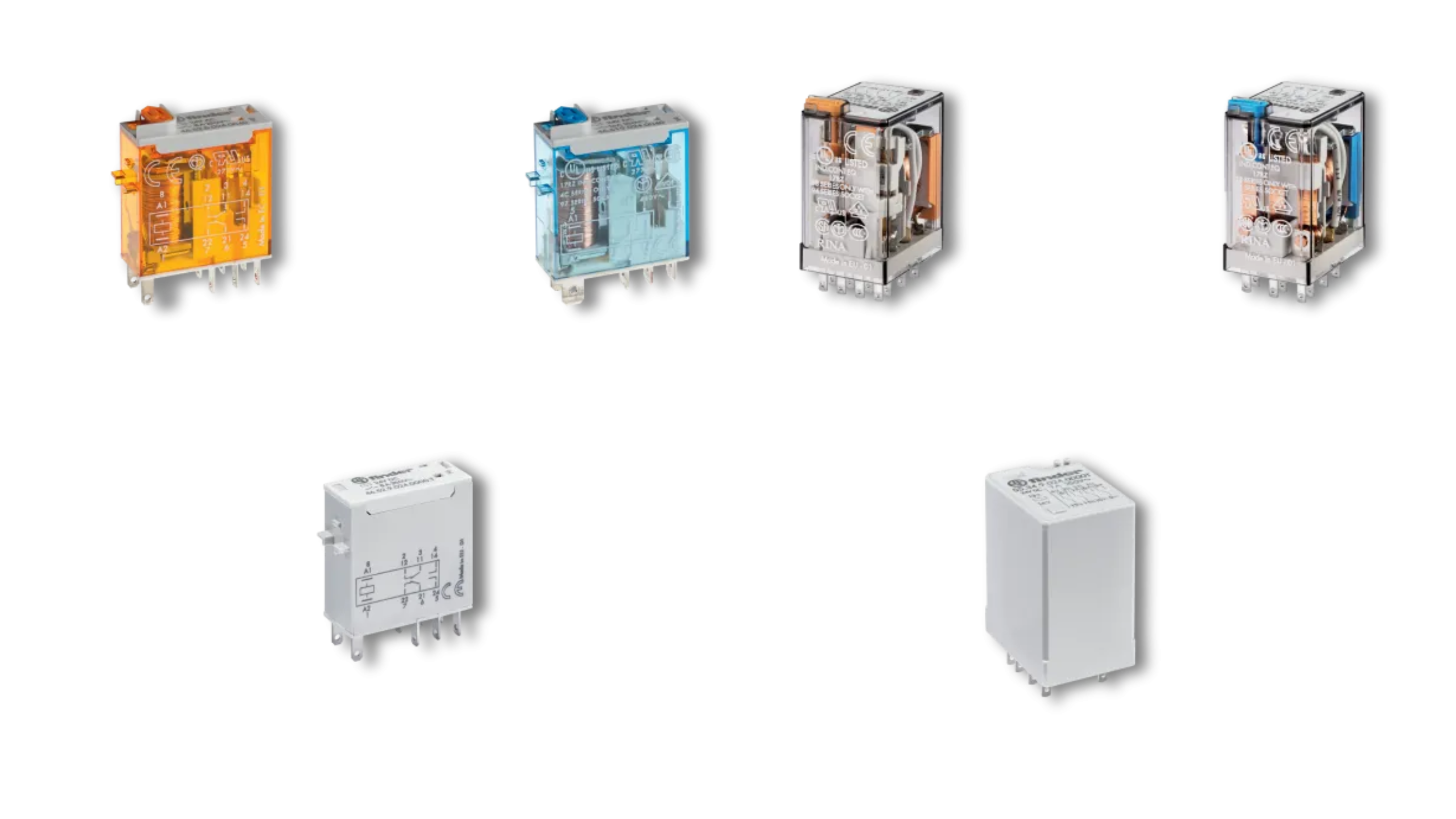
The Finder 46 and 55 Series are plug-in industrial relays designed for control panel applications. They mount into relay sockets, typically on a 35 mm DIN rail, allowing quick installation and easy replacement without disturbing wiring.
The 46 Series is a compact miniature industrial relay. The 55 Series is larger and offers more contact options, including 2, 3 and 4 pole changeover versions.
Current range
Typically 7 A to 16 A, depending on model and contact configuration.
Features
- Plug-in format
Relays can be removed and replaced in seconds, making maintenance simple. - Multiple contact configurations
The 55 Series offers up to four changeover contacts, allowing one relay to switch several circuits at once, such as power, signalling and feedback. - Clear status indication
Mechanical position indicators and optional LED modules make fault finding easier. - Lockable test button
Many versions allow manual actuation for testing and commissioning. - Modular accessories
Compatible sockets support coil suppression modules, RC filters and LED indicators to protect control electronics and reduce electrical noise. - Wide coil voltage options
Available in AC and DC coil variants to suit most control systems.
Common Uses
- Automation control panels
- HVAC systems
- Pump and fan control
- Machine control cabinets
- Auxiliary switching circuits
Choose Finder 46 or 55 Series
| Feature | Finder 46 Series | Finder 55 Series |
|---|---|---|
| Typical current rating | ~7 A | ~7 A to 16 A |
| Contact types | Usually DPDT | 2PDT, 3PDT and 4PDT options |
| Physical size | Smaller / more compact | Larger body to support more contacts |
| Best for | Space-limited panel layouts | Panels needing multiple circuits switched |
| Mechanical status indicator | Yes (many models) | Yes |
| Lockable test button | Available on some versions | Available on most versions |
| LED indicator support | Through socket modules | Through socket modules |
| Coil voltage options | AC and DC | AC and DC |
| Typical applications | Control panels, HVAC, PLC interfaces | Control panels with more circuits, auxiliary switching |
| Installation | Plug-in socket | Plug-in socket |
Industrial Signal and Plug-In Relays
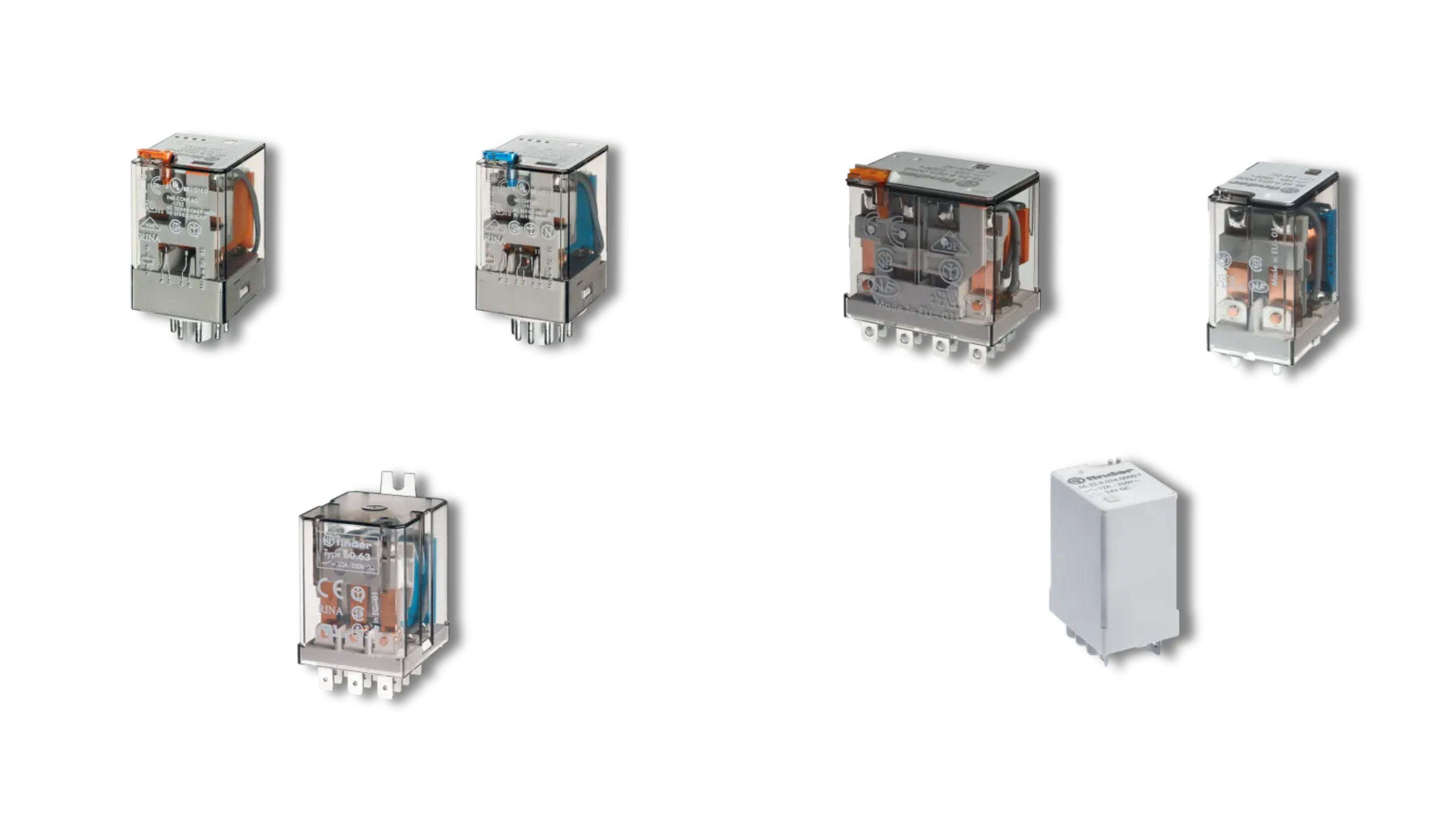
The Finder 56 and 60 Series are industrial plug-in relays designed for control and signal switching applications where contact reliability is especially important. Both series are mounted in plug-in sockets, typically on a 35 mm DIN rail, making them easy to install, replace and maintain.
The key difference to general purpose relays is that these ranges are optimised for switching low level signals as well as moderate power loads. That makes them particularly suitable for PLC interfacing and control logic circuits.
Current range
Typically 6 A to 12 A, depending on the model and contact configuration.
Features
- Bi-furcated contacts
Many versions of the 56 and 60 Series use bi-furcated contacts. Instead of a single contact tip, the moving contact splits into two independent contact points. This design provides:- Increased contact reliability
- Better performance when switching very small currents
- Reduced risk of contact oxidation affecting signal integrity
- Low level control signals, such as PLC inputs or sensor outputs, can be unreliable if contact pressure or surface condition is poor. Bi-furcated contacts improve electrical continuity in these situations.
- Plug-in industrial format
Both series use standard plug-in bases, allowing quick replacement without rewiring. This is especially useful in process environments where downtime must be minimised. - Mechanical status indication and test options
Many models include mechanical flags and optional test buttons, making commissioning and fault finding easier. - Flexible contact arrangements
Available in DPDT and 3PDT configurations, allowing multiple signal paths to be switched simultaneously. - AC and DC coil options
Wide coil voltage availability makes them compatible with most control systems.
Common features
- PLC output isolation
- Control panels
- Instrumentation signal switching
- Auxiliary control circuits
- Industrial automation systems
They are commonly used where a PLC output needs to control a field device while also providing feedback or interlocking functions.
Choose 56 or 60 Series
| Feature | Finder 56 Series | Finder 60 Series |
|---|---|---|
| Typical current rating | Up to 12 A | 6 A to 10 A |
| Contact configurations | 2PDT, 3PDT | 2PDT, 3PDT |
| Bi-furcated contacts | Available on selected versions | Commonly available |
| Primary strength | Mixed signal and moderate load switching | Signal and control circuit switching |
| Plug-in socket mounting | Yes | Yes |
| Mechanical indicator | Yes | Yes |
| Lockable test button | Yes (many models) | Yes (many models) |
| Typical applications | Control panels, auxiliary switching | PLC interfacing, instrumentation circuits |
| Best for | Combined signal and small power loads | Reliable low level signal switching |
Solid State Relays
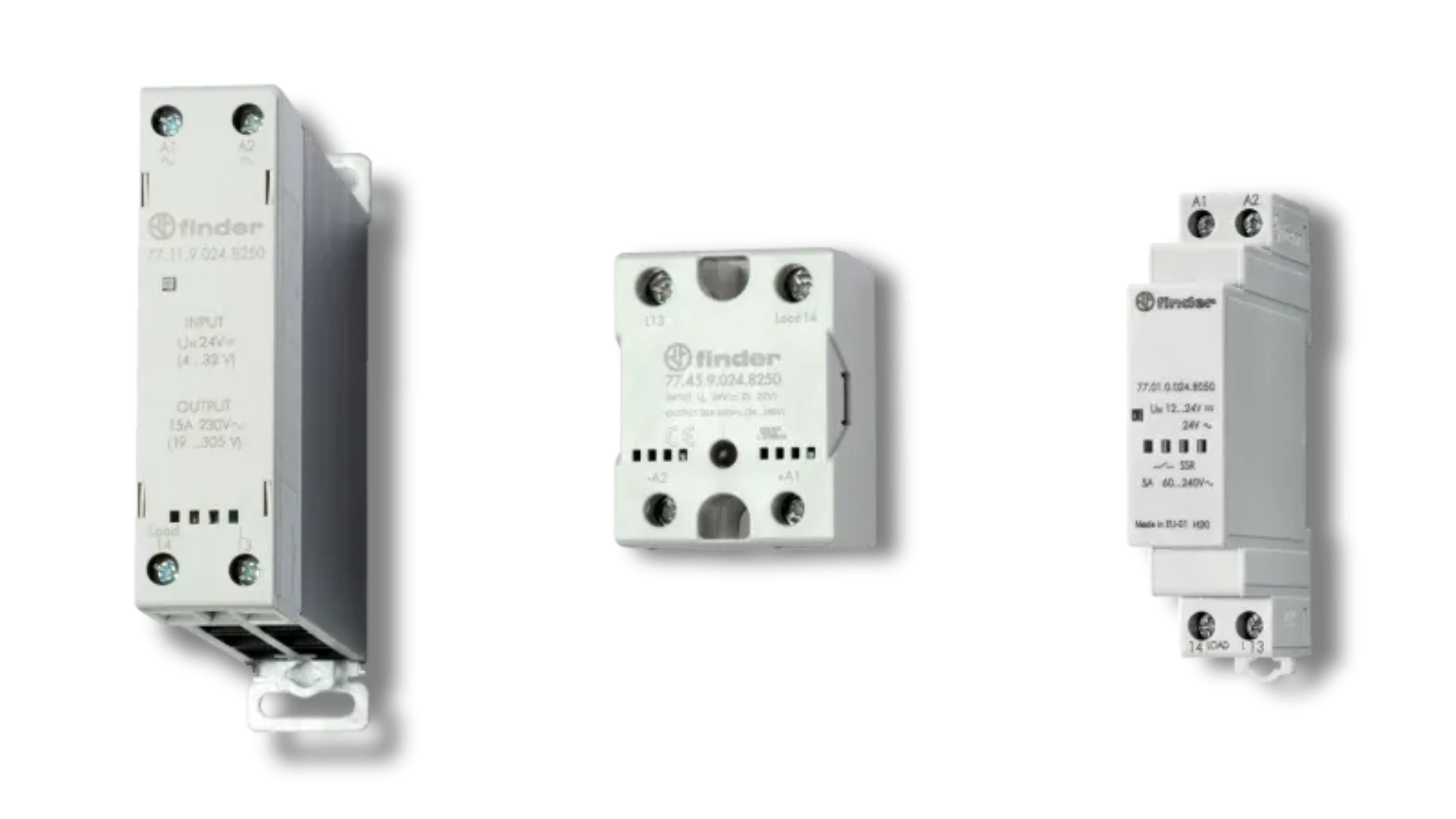
The Finder 77 Series are solid state relays, often referred to as SSRs. Unlike traditional electromechanical relays, they contain no moving parts. Switching is achieved entirely through electronic components. They are designed for applications where frequent switching, silent operation or long electrical life is required.
The 77 Series covers a wide range of industrial ratings and formats, making it suitable for both control panels and high power switching applications.
How do Solid State Relays work?
Instead of a coil and moving contact, a solid state relay uses semiconductor devices such as triacs, thyristors or transistors to switch the load. When a control voltage is applied to the input side, it activates an internal opto-isolator. This provides electrical isolation between the control circuit and the load circuit. The opto-isolator then triggers the semiconductor switching device, allowing current to flow through the output.
Many 77 Series models are zero-cross switching. This means they switch on when the AC waveform crosses zero volts, reducing electrical noise and inrush stress on the load.
Current range
Typically 5 A to 125 A, depending on the model and heat dissipation method.
Features
- No moving parts
This eliminates mechanical wear and greatly extends operational life in high switching frequency applications. - High switching frequency capability
Ideal for applications such as temperature control where switching may occur many times per minute. - Silent operation
Suitable for environments where clicking relays would be undesirable, such as laboratories or commercial buildings. - Reduced electrical noise
Zero-cross versions minimise electromagnetic interference. - High current capability
Models are available up to 125 A, suitable for substantial heating or power loads. - Long electrical life
Because there are no contact surfaces to erode, SSRs can significantly outlast mechanical relays in demanding applications.
Important considerations
Solid state relays generate heat during operation. Unlike mechanical relays, which have very low voltage drop across closed contacts, SSRs have a small internal voltage drop across the semiconductor. This results in power dissipation. For this reason:
- Proper heat sinking is essential
- Ventilation must be considered
- Load current must be carefully matched to the SSR rating
Failure to manage heat correctly can reduce lifespan.
Choose Finder 77 Series SSRs
| If your application involves… | Choose an SSR because… | Why a mechanical relay is less suitable |
|---|---|---|
| Frequent on/off switching (multiple times per minute) | There are no moving parts to wear out | Mechanical contacts wear and have a limited electrical life |
| PID temperature control | Zero-cross switching reduces electrical noise and stress on heating elements | Contact bounce and arcing can shorten relay life |
| Silent environments (laboratories, offices, commercial spaces) | Switching is completely silent | Mechanical relays produce audible clicking |
| Long duty cycles (relay energised for extended periods) | No mechanical contact heating or spring fatigue | Mechanical parts can fatigue over time |
| High vibration environments | No moving components to loosen or chatter | Mechanical contacts can be affected by vibration |
| High switching accuracy required | Fast electronic switching with no contact bounce | Mechanical relays have slower response and bounce |
| High current resistive loads (heaters, ovens) | Available up to 125 A with appropriate heat sinking | Mechanical relays may have shorter life at high switching frequency |
| Reduced maintenance requirements | Longer electrical life in high-cycle applications | Contacts may require periodic replacement |
PCB Relays
PCB relays are relays designed to mount directly onto a printed circuit board. Instead of plugging into a socket on a DIN rail, they are soldered onto a PCB as part of an electronic assembly. They are commonly used inside appliances, control boards and compact electronic equipment where space is limited and automated assembly is required.
PCB relays can be electromechanical, using moving contacts, or solid state, using semiconductor switching. They are typically chosen for low to medium current applications and where compact size is important. Two popular Finder PCB relay options are the 34 Series and the 41 Series.
Finder 34 Series – Ultra-Slim PCB Relays
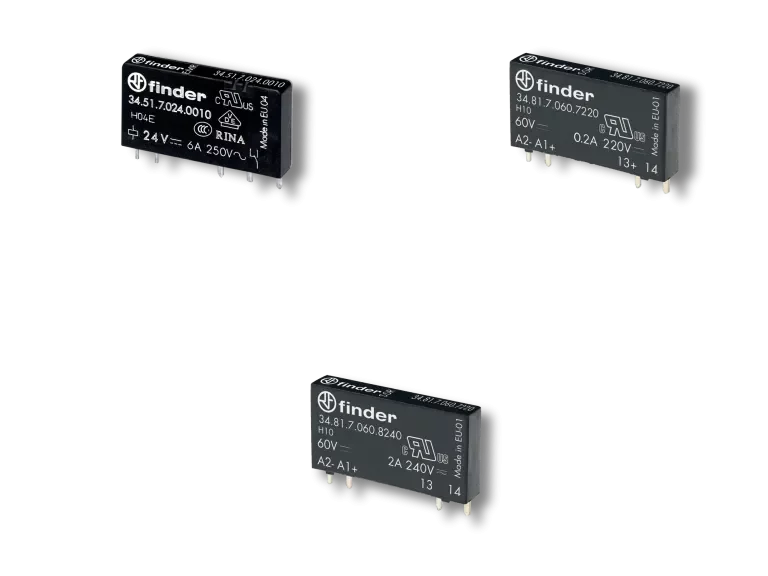
The Finder 34 Series is designed for applications where board space is extremely limited. At just 5 mm wide, it is one of the slimmest PCB relays available.
It is available in both electromechanical and solid state versions and is designed for direct PCB mounting.
Current range: 0.1 A to 6 A
Coil consumption: as low as 170 mW
Typical applications include:
- Vending machines
- PLC internal boards
- Compact control modules
The 34 Series is ideal when you need very low coil power consumption and maximum space saving. It is often selected for energy sensitive designs or tightly packed circuit boards.
Finder 41 Series – Low Profile PCB Relays
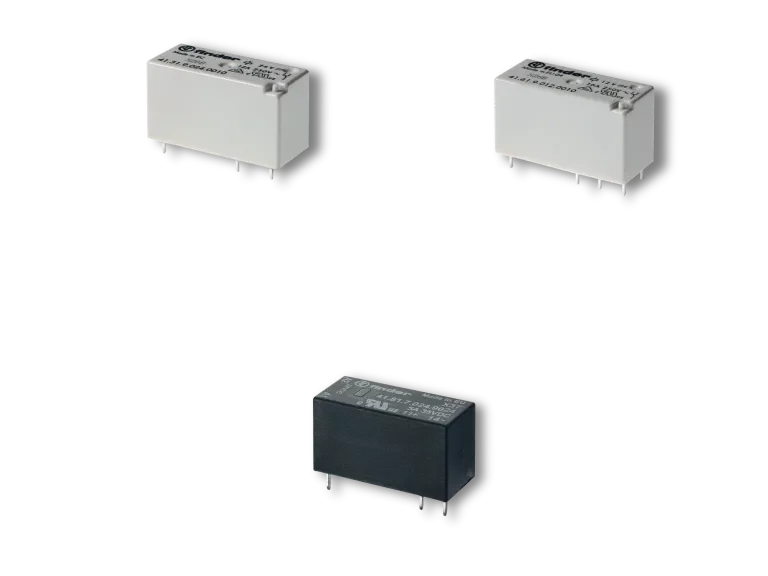
The Finder 41 Series is designed for low height applications where vertical space inside an enclosure is restricted. At only 15.7 mm high, it fits easily into compact housings.
Like the 34 Series, it is available in both electromechanical and solid state versions.
Current range: 3 A to 16 A
Typical applications include:
- Refrigerators
- Washing machines
- Boiler control boards
- Electric gate controllers
The 41 Series is chosen when more current capacity is required than ultra-slim relays can provide, but height inside the enclosure must still be kept to a minimum.
Choose Finder 34 or 41 series
| Feature | Finder 34 Series | Finder 41 Series |
|---|---|---|
| Design focus | Ultra-slim width | Low profile height |
| Width | 5 mm | Wider than 34 Series |
| Height | Standard PCB height | 15.7 mm low profile |
| Current range | 0.1 A to 6 A | 3 A to 16 A |
| Coil consumption | From 170 mW | Higher than 34 Series |
| Available versions | EMR and SSR | EMR and SSR |
| Best for | Tight board spacing | Higher current in compact enclosures |
| Typical applications | PLC boards, compact modules | Appliances, gate control, boiler boards |
In simple terms, choose the 34 Series when width and energy efficiency are the priority. Choose the 41 Series when you need higher current handling but still have limited enclosure height.
Power Relays for Higher Loads
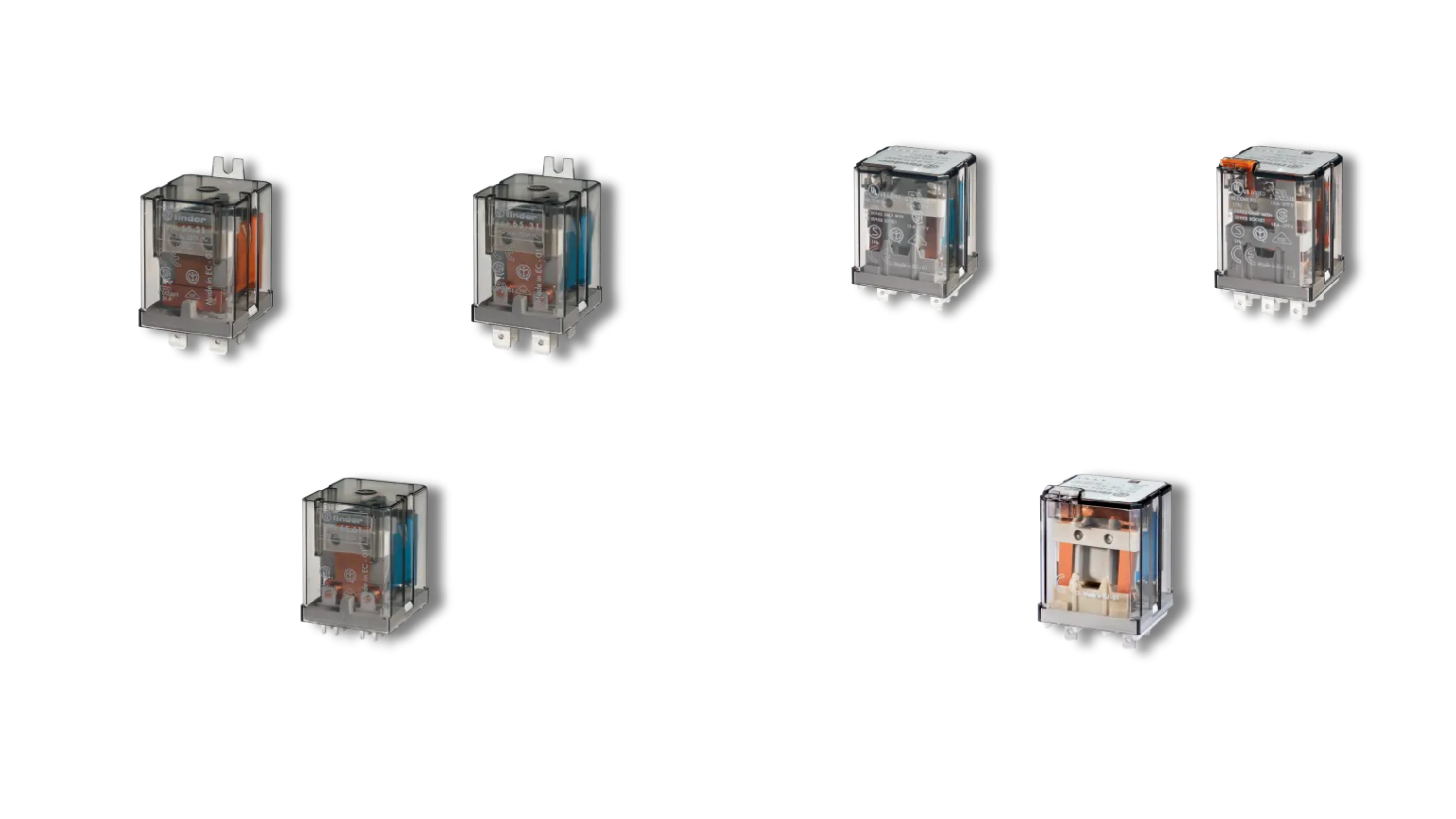
The Finder 62 and 65 Series are heavy duty electromechanical relays designed for switching higher current loads than standard control relays. They are typically used in industrial panels where moderate to high power circuits must be switched reliably, including DC circuits where arc management becomes critical.
The 62 Series is a versatile industrial power relay with multiple contact configurations and mounting options. The 65 Series is designed for higher current applications and includes versions with magnetic blow-out for improved DC switching performance.
Current range
Typically 16 A to 30 A, depending on model and configuration.
Features
- Higher contact ratings
Larger contact surfaces and stronger spring mechanisms allow reliable switching of heavier loads. - Magnetic blow-out options
Improves DC switching capability and extends contact life. - Multiple mounting options
Available in plug-in socket versions and PCB or flange mount options depending on the model. - Wide contact configurations
Including DPDT, 3PDT and DPST-NO versions. - Optional LED and test button features
Available on certain models to aid commissioning and maintenance.
Choose Finder 62 or 65 Series when:
- The load current exceeds typical control relay ratings
- You are switching DC circuits
- You require improved arc suppression
- The application involves moderate power but not full motor AC3 duty
They offer a practical middle ground between standard control relays and heavy industrial contactors.
| Feature | Finder 62 Series | Finder 65 Series |
|---|---|---|
| Typical current rating | Up to 16 A | 20 A to 30 A |
| Contact configurations | DPDT, 3PDT, DPST-NO, 3PST-NO | SPST-NO or dual SPST-NO |
| Magnetic blow-out versions | Available | Available on selected models |
| Mounting options | Plug-in socket, PCB, flange | PCB mount or Faston connection |
| Typical application focus | General industrial power switching | Higher current industrial loads |
| DC switching capability | Strong, especially with blow-out versions | Designed for heavier loads |
| Best for | Versatile panel power control | Higher current switching without moving to a contactor |
ATEX and Hazardous Area Relays
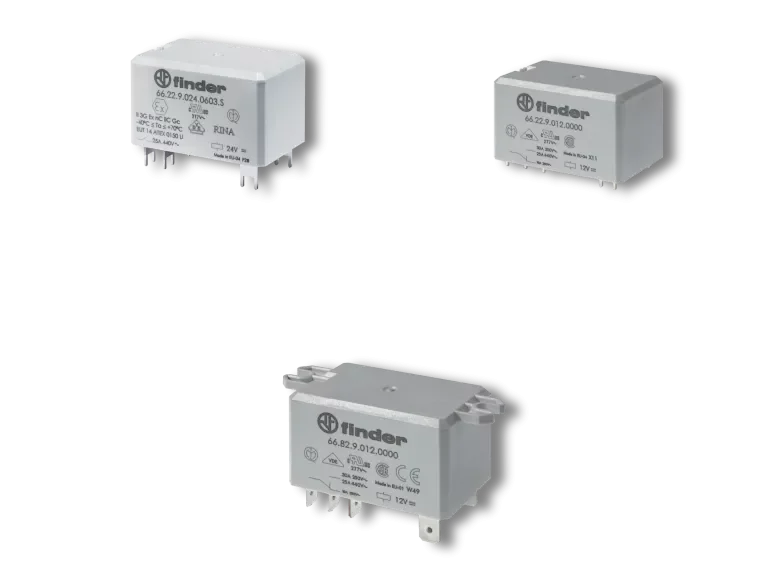
The Finder 66 Series is a power relay designed specifically for use in hazardous or potentially explosive environments where flammable gases, vapours or dust may be present. In these environments, electrical equipment must not create sparks, arcs or surface temperatures capable of igniting an explosive atmosphere.
The 66 Series allows reliable switching of industrial loads while maintaining compliance with hazardous area regulations such as ATEX and HazLoc..
Current range
Up to 30 A, depending on configuration.
Features
- Hazardous area certification
Tested and approved under ATEX and HazLoc standards for use in regulated environments. - High power capability
Up to 30 A, allowing control of substantial industrial loads. - DC and AC coil options
Compatible with standard industrial control systems. - Multiple mounting options
Available in PCB mount, flange mount and Faston terminal configurations depending on model. - Bi-furcated terminals
Improves electrical reliability and signal integrity.
Choose Finder 66 Series
| If your application involves… | Choose the 66 Series because… | It ensures… |
|---|---|---|
| ATEX Zone 2 classified area | It carries ATEX certification | Compliance with EU hazardous area regulations |
| HazLoc Class I Div. 2 environment | It is certified for hazardous gas locations | Safe operation in explosive atmospheres |
| LPG or fuel storage sites | It is designed for controlled arc management | Reduced ignition risk |
| Chemical vapour exposure | Certified construction and insulation distances | Regulatory compliance and safety |
| Switching moderate to high industrial loads in hazardous zones | Rated up to 30 A | Suitable power handling without moving to a contactor |
| Safety-critical compliance audits | Recognised international certifications | Easier approval and inspection acceptance |
High Power Relays for Renewable Energy
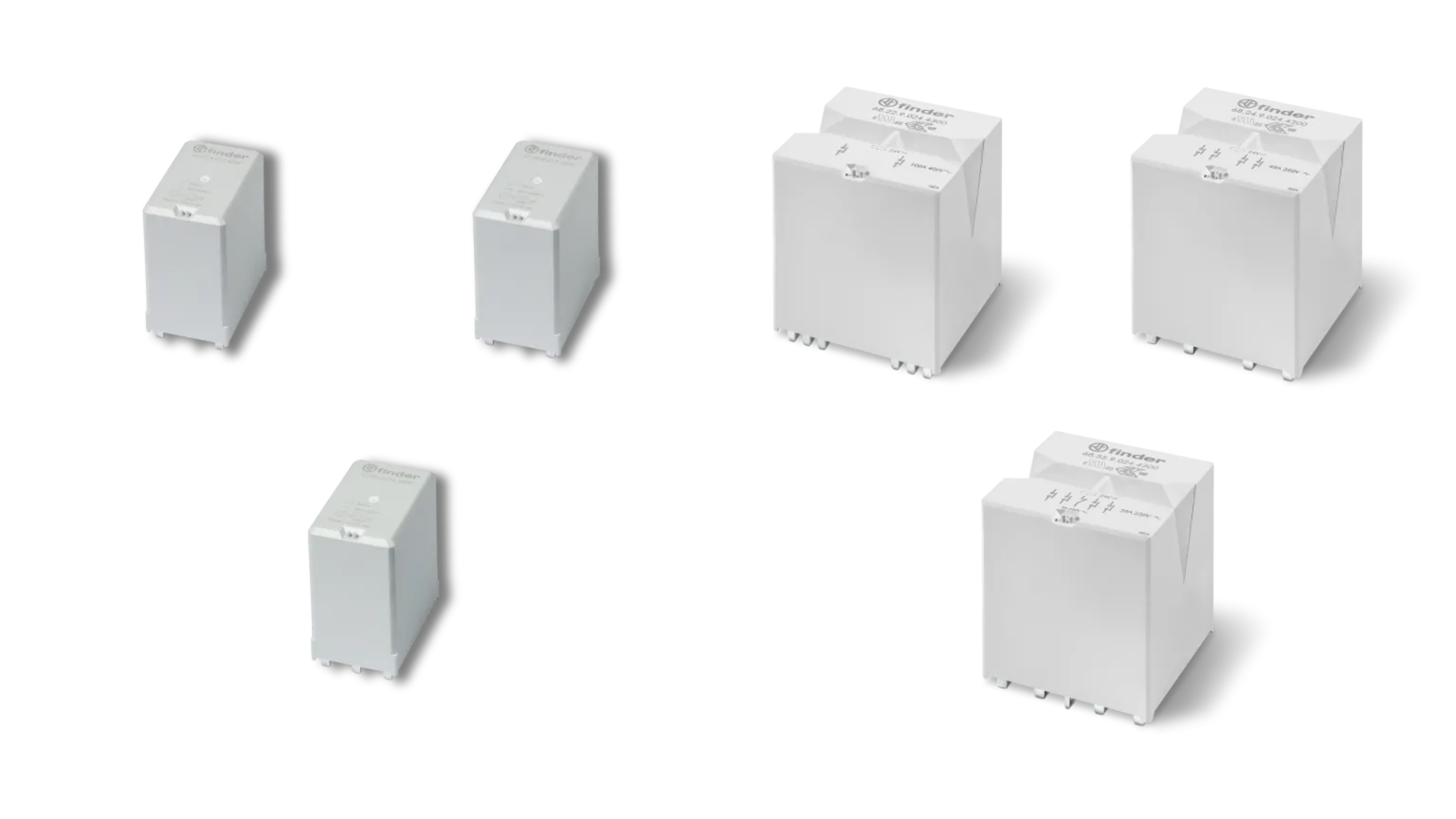
The Finder 67 and 68 Series are high current power relays designed for demanding energy applications, particularly within renewable energy and EV infrastructure.
These relays are engineered to handle substantial electrical loads while maintaining reliable switching performance under elevated temperatures and continuous duty conditions.
The 67 Series is primarily intended for photovoltaic and inverter-based systems.
The 68 Series extends capability further into very high current applications, including EV charging and battery energy storage systems.
Current Range
- Finder 67 Series: up to 50 A
- Finder 68 Series: 32 A to 100 A
The 68 Series includes models rated at 100 A and versions with auxiliary or mirror contacts for feedback and safety monitoring.
Features
- High current capability
Designed specifically for switching heavy resistive and DC loads common in renewable energy systems. - Low holding power DC coils
Both series use energy-efficient DC coils. Once energised, the holding power is low, reducing heat generation and energy consumption. - High ambient temperature operation
Suitable for elevated operating temperatures often found in inverter housings and power electronics enclosures. - Glow wire compliance
Meets EN 60335-1 requirements for resistance to heat and fire, supporting use in safety-conscious electrical installations. - Mirror and feedback contacts (68 Series)
Certain 68 Series models include mirror contacts in accordance with EN 60947-4-1 Annex F. These provide reliable status feedback, particularly important in EV charging systems. - EV charging compliance (68 Series)
Selected models comply with IEC 62955, making them suitable for use in electric vehicle charging stations where residual direct current detection is required. - PCB mounting for power electronics integration
Designed for direct integration into inverter and power board assemblies.
| Feature | Finder 67 Series | Finder 68 Series |
|---|---|---|
| Maximum current rating | Up to 50 A | 32 A, 40 A and up to 100 A |
| Primary application focus | Photovoltaic and inverter systems | High current EV and energy storage systems |
| Mirror contact availability | Not typical | Available on selected models |
| IEC 62955 EV compliance | No | Yes (selected models) |
| Coil type | Low holding power DC coil | Low holding power DC coil |
| High ambient temperature capability | Yes | Yes |
| Glow wire compliance | Yes | Yes |
| PCB integration | Yes | Yes |
| Best suited for | PV and medium-high current switching | Very high current and EV charging infrastructure |
Interface Relays for PLC Systems
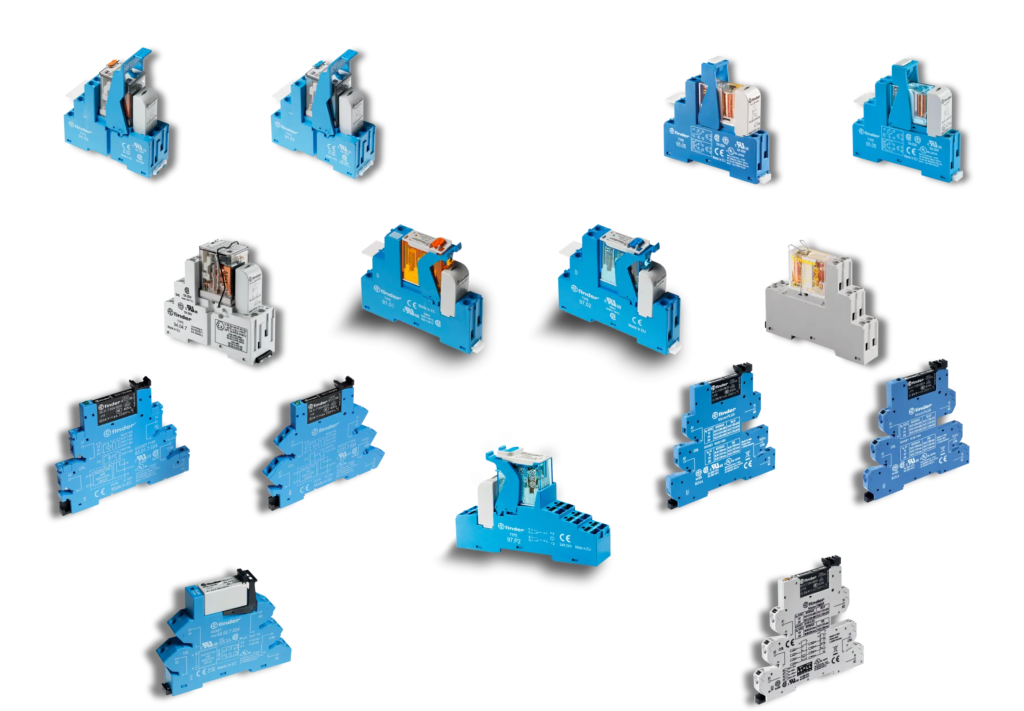
Finder interface relays are slim DIN rail mounted modules designed to sit between low power PLC outputs and higher power field devices.
They provide electrical isolation, protect sensitive control electronics and simplify wiring inside automation panels. Rather than wiring directly from a PLC to a load, the PLC drives the relay coil, and the relay contacts switch the field circuit.
These modules are compact, modular and designed for high density control panels where space, clarity and maintainability are important.
The range includes ultra-slim modules as narrow as 6.2 mm, multi-pole interface relays and versions suitable for hazardous areas.
Current Range
Up to 16 A, depending on the series and configuration.
Most interface relays are used in control and auxiliary switching rather than heavy power switching, making this current range ideal for valves, contactor coils, signalling devices and smaller loads.
Features
- Slim DIN rail format
Designed for high density panel layouts. Some models are only 6.2 mm wide. - EMR and SSR options
Available with electromechanical relay outputs or solid state outputs, depending on application needs. - Integrated coil indication and suppression
Many versions include built-in LED indicators and EMC suppression modules to protect PLC outputs from back EMF. - Push-in or screw terminal options
Allows flexible wiring methods and faster installation. - Fuse module options (selected models)
Some series allow plug-in fuse modules for output circuit protection. - ATEX and HazLoc versions (selected models)
Certain ranges, such as parts of the 39 and 58 Series, are available with hazardous area certification. - Multi-pole configurations
Available in single, double, triple and four pole variants depending on the series.
Choose 38, 39, 48, 4C or 58 Series
| Feature | 38 Series | 39 Series (MasterINTERFACE) | 48 Series | 4C Series | 58 Series |
|---|---|---|---|---|---|
| Typical width | 6.2 mm ultra-slim | 6.2 mm ultra-slim | 15.8 mm | 15.8 mm | 27 mm |
| Max current | Up to 16 A | Up to 6 A | Up to 16 A | Up to 16 A | Up to 10 A |
| EMR versions | Yes | Yes | Yes | Yes | Yes |
| SSR versions | Yes (selected models) | Yes (selected models) | Limited | Limited | No |
| ATEX / HazLoc options | Limited | Available | No | No | Available |
| Integrated coil suppression | Yes | Yes | Yes | Yes | Yes |
| Multi-pole options | SPDT, DPDT | SPDT | SPDT, DPDT | SPDT, DPDT | DPDT, 3PDT, 4PDT |
| Best suited for | High density PLC panels | Ultra-compact PLC interfacing | Higher current interface switching | General panel interfacing | Multi-contact or hazardous area interfacing |
Choose the 38 or 39 Series when panel space is extremely limited and high density PLC interfacing is required.
Choose the 48 or 4C Series when higher current interface switching is needed in a slightly wider format.
Choose the 58 Series when multiple contacts are required in one module or when hazardous area certification is necessary.
Safety Relays With Forcibly Guided Contacts
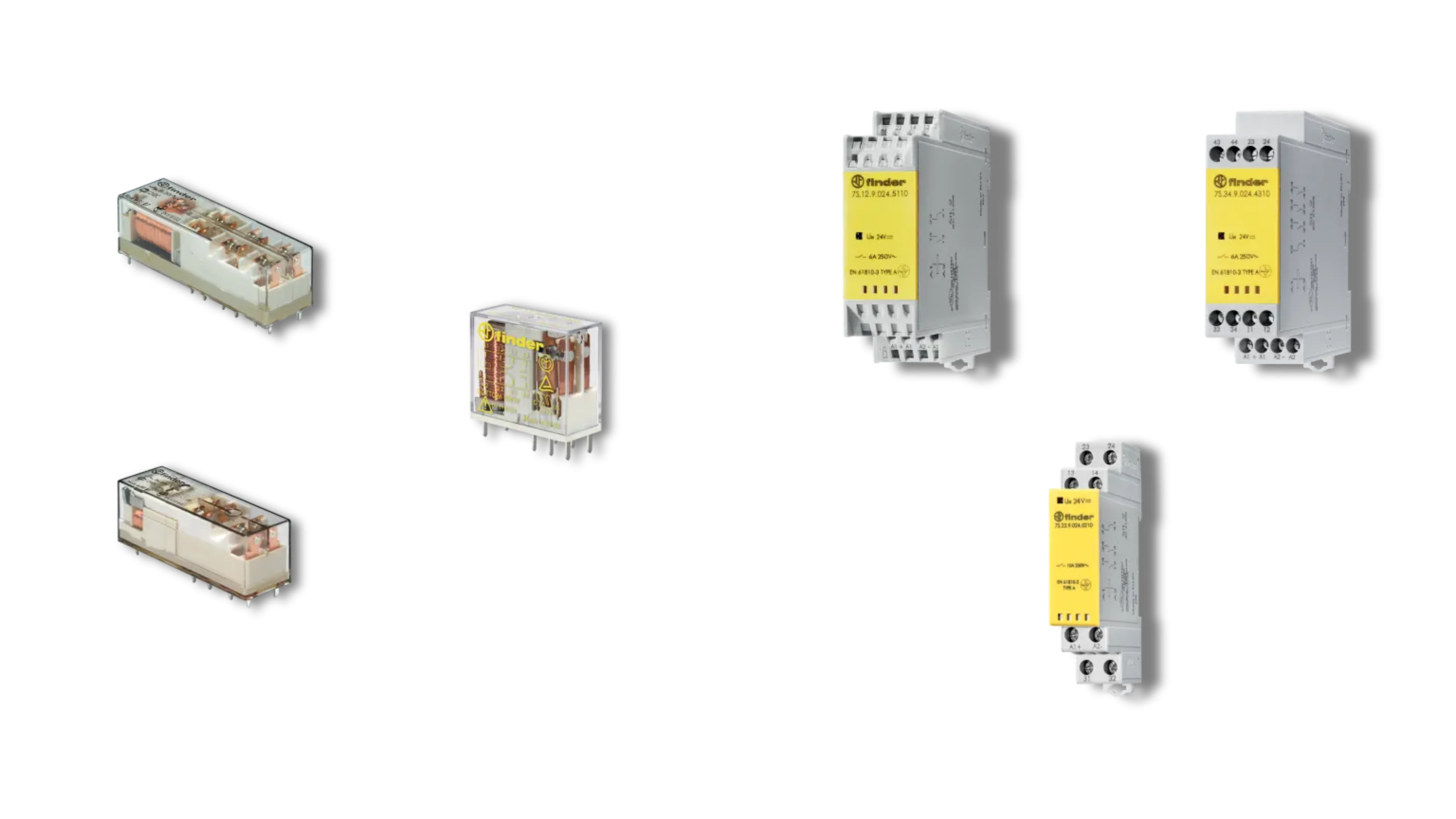
The Finder 50 and 7S Series are safety relays with forcibly guided contacts designed for use in safety-related control circuits. Unlike standard relays, they use mechanically linked contact sets. This means the normally open and normally closed contacts are physically connected so they cannot move into conflicting states.
They comply with EN 61810-3, the standard covering forcibly guided contact relays used in safety applications.
The 50 Series is typically PCB mounted for integration into safety boards and OEM equipment.
The 7S Series is a modular DIN rail mounted version designed for control panels.
Current Range
Typically up to 6 A to 10 A depending on configuration. These relays are intended for safety control circuits rather than high power switching.
Features
- Forcibly guided contact mechanism
Mechanically linked contacts prevent false safe signals if one contact welds. - Safety standard compliance
Designed to meet EN 61810-3 requirements for safety circuits. - Multiple NO and NC combinations
Available in configurations such as 2 NO + 2 NC, 3 NO + 1 NC and other safety-relevant combinations. - PCB or DIN rail mounting options
50 Series for board-level integration.
7S Series for modular panel installation. - Clear mechanical indication
Supports diagnostics and visual verification during maintenance.
Choose 50 Series or 7S Series
| Feature | Finder 50 Series | Finder 7S Series |
|---|---|---|
| Mounting format | PCB mount | DIN rail modular |
| Typical integration | Embedded in equipment | Installed in control panels |
| EN 61810-3 compliance | Yes | Yes |
| Mechanically linked contacts | Yes | Yes |
| Contact configurations | Multiple safety combinations | Multiple safety combinations |
| Best suited for | OEM safety board integration | Panel-based safety circuits |
| Replacement method | Board-level replacement | Plug-in DIN module replacement |
Choose the 50 Series when integrating safety relays directly into machine control boards or OEM assemblies.
Choose the 7S Series when installing safety circuits within a DIN rail control panel where modular replacement and accessibility are priorities.
Programmable Logic Relays
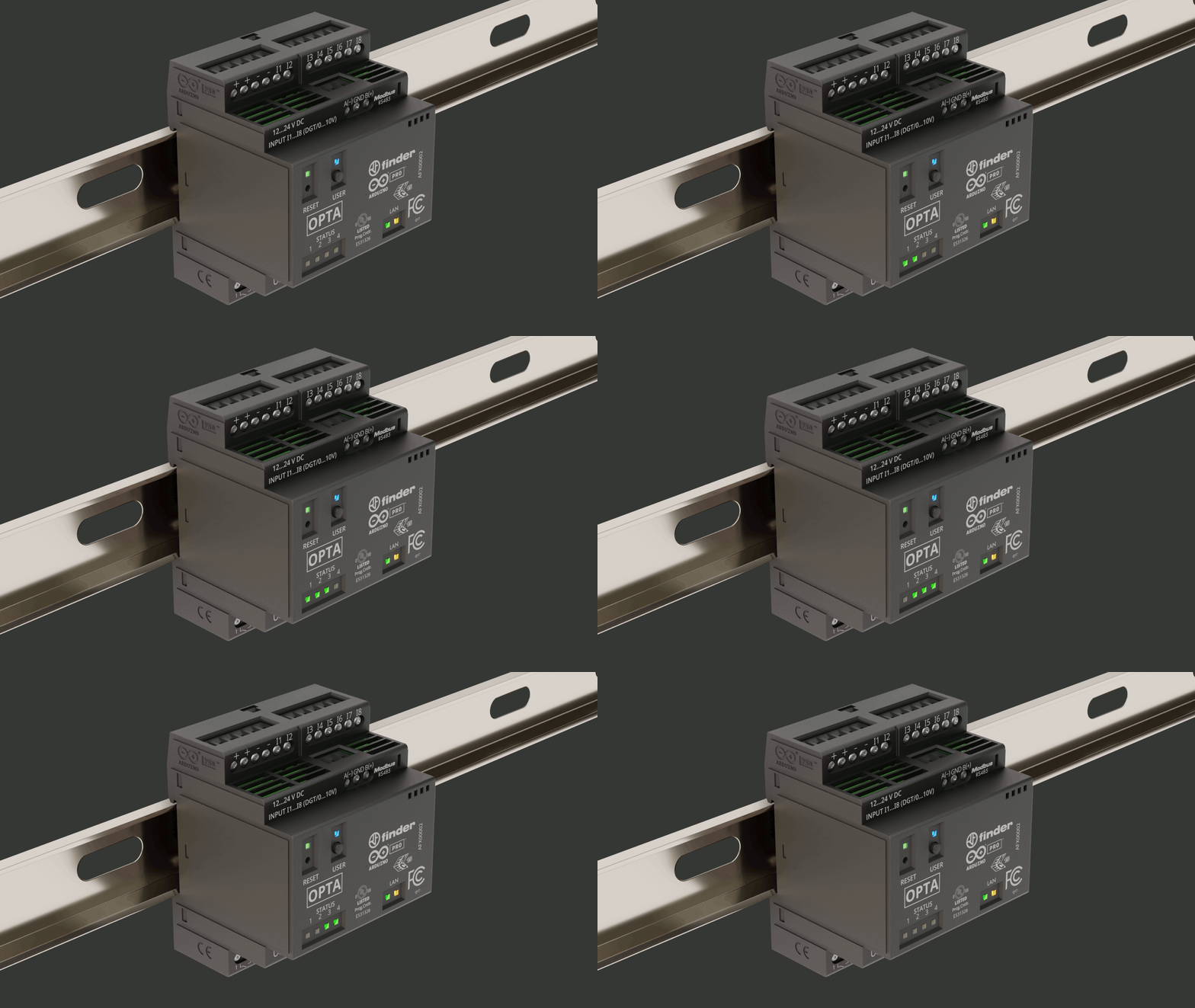
The Finder 8A Series OPTA is a programmable logic relay that combines PLC functionality with integrated relay outputs in a single DIN rail mounted device.
It is designed for applications where control logic, connectivity and power switching are required within one compact module. It is available in different versions, including Lite, Plus and Advanced models, offering varying levels of connectivity and communication capability.
Current Range
• 4 relay outputs rated at 10 A each
• Expansion modules available with additional relay or solid state outputs
The integrated relay outputs are suitable for switching moderate industrial loads such as lighting circuits, valves, contactor coils and small motors.
Features
- Integrated logic control
Supports programming using Codesys (IEC 61131-3 languages such as Ladder and Function Block Diagram) or Arduino IDE for open-source flexibility. - Digital and analogue inputs
8 configurable inputs supporting digital signals and analogue inputs such as 0 to 10 V. - Relay outputs
4 normally open relay outputs rated at 10 A. - Connectivity options
Depending on model, includes Ethernet, RS485 (Modbus RTU), Modbus TCP/IP and Wi-Fi/BLE connectivity. - Dual-core processor
Provides high processing performance for real-time control and data handling. - Secure crypto chip
Enhances cybersecurity for connected applications and IoT environments. - Expansion capability
Optional expansion modules allow additional digital inputs, analogue inputs and outputs, EMR outputs or solid state outputs. - DIN rail mounting
Compact modular design suitable for control panels and automation cabinets.
Choose 8A Series OPTA
| If your application requires… | Choose 8A Series OPTA because… |
|---|---|
| PLC logic and relay outputs in one device | It integrates programmable control and 10 A relay outputs |
| Remote connectivity and monitoring | Ethernet, RS485 and Wi-Fi/BLE options are available |
| Building automation control | Supports analogue inputs and flexible programming |
| OEM smart product integration | Compact DIN format reduces component count |
| Secure IoT connectivity | Built-in crypto chip enhances security |
| Expandable I/O capability | Optional expansion modules increase inputs and outputs |
| Reduced panel space | Replaces separate PLC and interface relays |
When you need intelligent control and relay switching combined in one compact, connected and expandable DIN rail module, the OPTA is the only choice. Read more about the OPTA range on our blog here.

How to Choose the Right Relay
Ask yourself:
- What current does the load draw?
- Is it AC or DC?
- Is the load resistive or inductive?
- How often will it switch?
- Is the environment hazardous?
- Is space limited?
- Does the system require safety compliance?
Choosing the correct relay improves reliability, safety and lifespan.
Which is the Relay for you?
| If your application requires… | Recommended relay type | Typical current range | Why this type suits the application |
|---|---|---|---|
| Switching directly on a printed circuit board with limited space | PCB Relay (e.g. Finder 34 or 41 Series) | 0.1 A to 16 A | Compact size and designed for PCB mounting |
| General control panel switching of auxiliary circuits | General Purpose Industrial Relay (e.g. Finder 46 or 55 Series) | 7 A to 16 A | Cost effective, flexible contact options and easy plug-in replacement |
| Switching moderate power loads, including DC circuits | Power Relay (e.g. Finder 62 or 65 Series) | 16 A to 30 A | Higher current capability and improved arc management for DC |
| Switching very high currents in EV, battery or solar systems | High Power Relay (e.g. Finder 67 or 68 Series) | 32 A to 100 A | Designed for high current renewable and EV applications |
| Protecting PLC outputs and simplifying panel wiring | Interface Relay (e.g. Finder 38, 39, 48, 4C or 58 Series) | Up to 16 A | Slim DIN format with coil suppression and easy wiring |
| Building safety circuits such as emergency stops or guard monitoring | Safety Relay with forcibly guided contacts (e.g. Finder 50 or 7S Series) | Typically 6 A to 10 A | Mechanically linked contacts for reliable fault detection |
| Frequent, silent or high-speed switching of resistive loads | Solid State Relay (e.g. Finder 77 Series) | 5 A to 125 A | No moving parts, long life and silent operation |
| Combining programmable logic control and relay switching in one DIN module | Programmable Logic Relay (Finder 8A Series OPTA) | 4 × 10 A relay outputs (expandable) | Integrates PLC functionality, connectivity and relay outputs in a compact unit |
Need More Help?
As a Finder Official Premium Partner, LED Controls stocks a comprehensive range of Finder relays, from ultra-slim PCB types to 100 A high power solutions. If you are unsure which relay is the one for your application, get in touch and we can help you select the correct relay for your project.