Standard delivery
£8 ex VAT · free over £200UK parcel delivery is £8 ex VAT, or free on orders over £200 ex VAT.
Heavier items may be charged at a weight-based or pallet rate, shown at checkout.
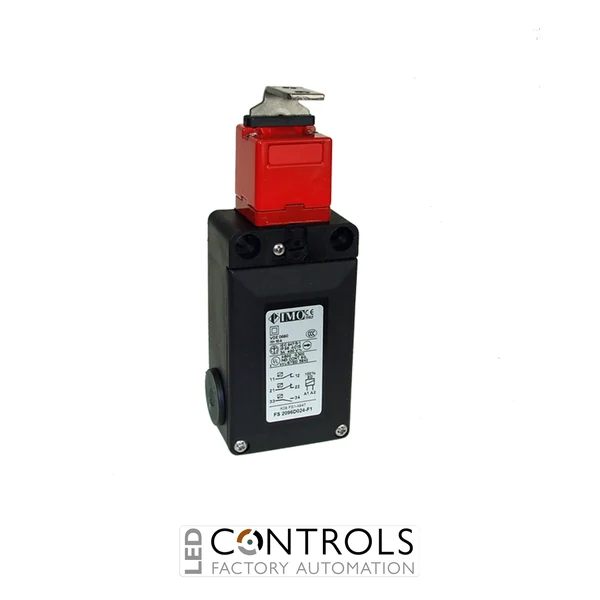
The IMO PSC206OF024-F1 is a 24 V AC/DC power-to-release safety door interlock with a 90° actuator, 1NO + 2NC contacts and IP67 protection for machine guarding systems.
£169.14
The IMO PSC206OF024-F1 is a solenoid-operated safety door interlock with a 90° key actuator. It is intended for machine guarding systems that require actuator-based interlocking and electrically controlled guard release.
This model has a 1NO + 2NC contact arrangement for connection to the associated control circuit. Its angled actuator provides a different mounting geometry from the flat actuator version, helping accommodate the mechanical layout of an appropriate guard installation.
The 24 V AC/DC solenoid operates on a power-to-release principle. The IMO Starline catalogue identifies this exact variant as “On to Release”, allowing unlocking to be coordinated with the machine's control sequence.
Guard locking allows access to be coordinated with the machine's stopping sequence. In a power-to-release arrangement, energising the release solenoid permits unlocking; the control system must determine when access is appropriate for the hazards involved.
The complete safety function depends on the guard installation, actuator alignment, contact wiring, monitoring equipment and stopping behaviour. The interlock must be integrated and validated as part of that system rather than treated as a standalone guarantee of machine safety.
| Manufacturer | IMO |
|---|---|
| Model | PSC206OF024-F1 |
| Product type | Safety door interlock |
| Actuation | Separate key actuator |
| Actuator geometry | 90° |
| Locking mechanism | Solenoid operated |
| Release principle | Power to release |
| Solenoid supply | 24 V AC/DC |
| Contact arrangement | 1NO + 2NC |
| Protection rating | IP67 |
It provides key-actuated guard interlocking and solenoid-controlled release as part of a machine safety system.
The solenoid is specified for 24 V AC/DC.
The PSC206OF024-F1 uses a 90° actuator.
It has 1NO + 2NC, meaning one normally open contact and two normally closed contacts.
The release solenoid must be energised to permit unlocking, with the machine control system coordinating release when the relevant hazard has ceased.
Correctly selected guard interlocks support controlled access and coordinated machine operation within a properly designed and validated safeguarding system.
We use cookies
We use essential cookies to run this site, your basket and checkout. With your permission we'd also like to use analytics and advertising cookies to understand how the site is used and to measure our adverts.