Standard delivery
£8 ex VAT · free over £200UK parcel delivery is £8 ex VAT, or free on orders over £200 ex VAT.
Heavier items may be charged at a weight-based or pallet rate, shown at checkout.
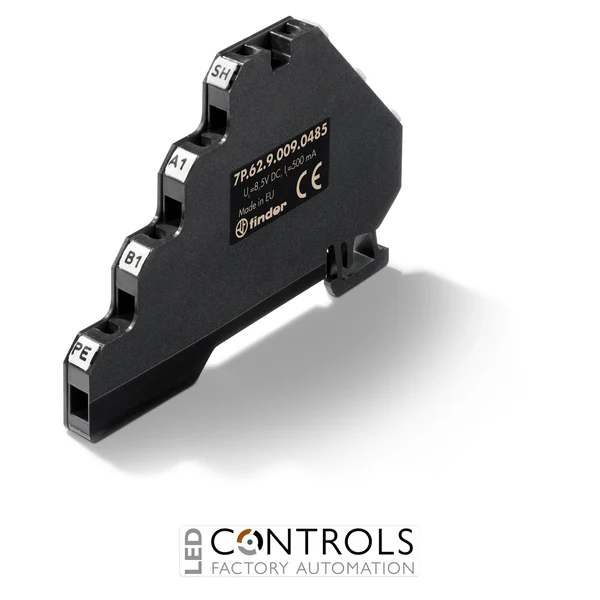
Finder 7P.62.9.036.0005 is a compact Type 2+3 surge protection device for compatible two-wire data, telecommunications and fire detection signalling circuits. Featuring 24 V DC nominal voltage, 36 V DC maximum operating voltage, 0.5 A nominal load current, 5 kA C2 core-to-core nominal discharge current, 10 kA total cores-to-earth discharge current, 1 ns response time and a slim 6 mm DIN rail housing.
£55.25
The Finder 7P.62.9.036.0005 is a compact Type 2+3 surge protection device (SPD) designed to protect two-wire data lines, telecommunications interfaces, fire detection systems and low-voltage signalling circuits against transient overvoltages. Part of the Finder 7P Series, this specialist surge arrester combines coarse and fine surge suppression to help safeguard sensitive electronic equipment from electrical disturbances.
Designed for 24 V DC nominal signal circuits, the Finder 7P.62.9.036.0005 has a maximum continuous operating voltage (Uc) of 36 V DC and a nominal load current of 0.5 A. These characteristics make it suitable for compatible low-voltage signalling and communications applications where conventional mains surge protection devices would not provide the required protection characteristics.
The device provides a 5 kA nominal discharge current between signal cores and a 10 kA total discharge current between the combined cores and protective earth, measured using the 8/20 µs waveform. Its combined Type 2+3 protection provides both coarse and fine suppression, helping reduce transient voltage exposure on connected signal and data equipment.
With a slim 6 mm housing width, the Finder 7P.62.9.036.0005 is particularly well suited to control panels and communications cabinets where DIN rail space is limited. The device supports serial connection of two-wire signal circuits, helping protect against both line-to-line and line-to-earth transient overvoltages while allowing continuity of the cable shield.
Its combination of fast response, compact construction and specialist data-line protection makes the Finder 7P.62.9.036.0005 a practical choice for electrical contractors, fire detection engineers, industrial panel builders and telecommunications maintenance professionals.
Low-voltage data and signalling circuits can be particularly vulnerable to transient overvoltages. Long cable runs, connections between different areas of a building and wiring installed near electrical power equipment can expose sensitive signal interfaces to disturbances caused by switching operations and nearby lightning activity.
The Finder 7P.62.9.036.0005 is designed to help reduce these risks by providing combined Type 2+3 surge protection for compatible two-wire circuits. Its protection arrangement addresses both differential-mode and common-mode transient overvoltages.
Differential-mode protection operates between the two signal conductors, helping limit excessive voltage differences that could damage connected electronic interfaces. Common-mode protection operates between the signal conductors and protective earth, helping divert surges that affect both conductors relative to earth.
The device is designed for serial installation within the signal path, providing protection at the point where the cable enters or connects to sensitive equipment. Its connection arrangement also allows continuity of the cable shield, an important consideration for compatible shielded telecommunications and signalling systems.
With a 24 V DC nominal voltage and 36 V DC maximum operating voltage, the device is suitable for selected low-voltage signalling applications. However, compatibility must be assessed using the actual operating voltage, current, signal frequency and electrical characteristics of the protected interface.
The 0.5 A nominal load current and 1.6 Ω series resistance per core are particularly important when protecting powered signalling circuits. These values should be considered when assessing permissible voltage drop and the effect of the SPD on normal signal transmission.
The Finder 7P.62.9.036.0005 combines coarse and fine surge suppression to provide protection against transient overvoltages in compatible data and signalling circuits.
Under the C2 test classification, the device provides a 5 kA nominal discharge current between the signal cores and a 10 kA total discharge current between the combined cores and protective earth, using the 8/20 µs waveform.
The specified C2 voltage protection level is 50 V core-to-core and 65 V core-to-PE at the nominal discharge current. These figures help engineers assess the transient voltage exposure of connected equipment under the relevant test conditions.
Under the C3 test classification, the device provides a 45 V voltage protection level for both core-to-core and core-to-PE modes at a voltage rise rate of 1 kV/µs.
The specified 1 ns response time supports rapid reaction to transient overvoltages. Effective protection also depends on installation wiring, protective earthing, cable routing and the impulse withstand capability of connected equipment.
The Finder 7P.62.9.036.0005 is a signal-line SPD, not a replacement for a mains power surge protector. Where equipment has both power and communications connections, each relevant connection may require appropriately coordinated protection.
The Finder 7P.62.9.036.0005 mounts onto a standard 35 mm DIN rail according to EN 60715. With a housing width of only 6 mm, it can be incorporated into densely populated electrical control panels, fire detection cabinets and telecommunications enclosures.
The device is designed for in-line connection of a two-wire circuit. The incoming and outgoing signal conductors must be connected according to Finder's terminal diagram, with the protective earth and cable shield connections arranged as specified by the manufacturer.
Correct earthing is essential for effective common-mode surge protection. The protective earth connection should provide a suitable low-impedance path for transient surge current, with wiring kept as short and direct as practicable.
When selecting the device, engineers should verify that the protected circuit does not exceed the 36 V DC maximum operating voltage or the 0.5 A nominal load current. The 1.6 Ω series resistance per core and 4 MHz threshold frequency must also be considered to ensure compatibility with the intended signalling protocol.
The device accepts conductors up to 4 mm² solid or 2.5 mm² stranded, subject to the manufacturer's connection requirements. Its IP20 rating means it must be installed within a suitable enclosure.
Installation and maintenance should be carried out by a competent professional following the manufacturer's instructions and applicable electrical, telecommunications or fire detection system standards.
| Manufacturer | Finder |
|---|---|
| Series | 7P Series |
| Product family | 7P.62 |
| Manufacturer part number | 7P.62.9.036.0005 |
| Alternative code | 7P6290360005 |
| EAN / GTIN | 8012823401256 |
| Product type | Data and signal surge protection device |
| SPD classification | Type 2+3 |
| Protection arrangement | Two-wire signal circuit |
| Nominal voltage (Un) | 24 V DC |
| Maximum continuous operating voltage (Uc) | 36 V DC |
| Nominal load current (IL) | 0.5 A |
| C2 nominal discharge current, core-to-core (In) | 5 kA |
| C2 total discharge current, cores-to-PE | 10 kA |
| Discharge current waveform | 8/20 µs |
| C2 voltage protection level, core-to-core at In | 50 V |
| C2 voltage protection level, core-to-PE at In | 65 V |
| C3 voltage protection level, core-to-core at 1 kV/µs | 45 V |
| C3 voltage protection level, core-to-PE at 1 kV/µs | 45 V |
| Response time, core-to-core | 1 ns |
| Response time, core-to-PE | 1 ns |
| Series resistance per core | 1.6 Ω |
| Threshold frequency, core-to-core | 4 MHz |
| Signal connection | Serial / in-line |
| Protection modes | Core-to-core and core-to-protective-earth |
| Shield continuity | Supported |
| Mounting | 35 mm DIN rail, EN 60715 |
| Height | 91 mm |
| Width | 6 mm |
| Depth | 58 mm |
| Maximum solid conductor size | 4 mm² |
| Maximum stranded conductor size | 2.5 mm² |
| Ingress protection | IP20 |
| Operating temperature range | -40 °C to +70 °C |
| Applicable surge protection standard | EN 61643-21 |
| Approximate net weight | 33.6 g |
| Country of origin | Czechia |
| Typical applications | Fire detection systems, telecommunications interfaces and two-wire data lines |
The Finder 7P.62.9.036.0005 is a Type 2+3 surge protection device designed for compatible two-wire telecommunications, data and signalling circuits. It helps protect sensitive electronic interfaces against transient overvoltages.
Yes. Finder identifies this model as suitable for protecting compatible fire detection systems, telecommunications interfaces and two-wire data lines. Its suitability for a specific fire detection installation must be checked against the system manufacturer's requirements and applicable standards.
The device has a nominal voltage (Un) of 24 V DC and a maximum continuous operating voltage (Uc) of 36 V DC.
Type 2+3 indicates combined coarse and fine surge suppression for compatible data and signal circuits. The Finder 7P.62.9.036.0005 is tested for C2 and C3 performance under the relevant signal-line surge protection standard.
The device has a C2 nominal discharge current of 5 kA between the two signal cores and a 10 kA total discharge current between the combined cores and protective earth, measured using the 8/20 µs waveform.
Under C2 testing, the voltage protection level is 50 V core-to-core and 65 V core-to-PE. Under C3 testing at 1 kV/µs, the protection level is 45 V for both protection modes.
Yes. The device provides protection against differential-mode transients between the two signal cores and common-mode transients between the cores and protective earth.
The Finder 7P.62 family includes devices for RS485 and other data networks. However, the 7P.62.9.036.0005 is specifically identified for fire detection, telecommunications and two-wire data applications. Its suitability for a particular RS485 network must be checked against the signal voltage, frequency and transmission requirements. Finder also offers the 7P.62.9.009.0485 variant specifically for RS485 applications.
The device has a nominal load current of 0.5 A. The protected circuit must operate within this limit.
The device has a slim 6 mm housing width and mounts onto a standard 35 mm DIN rail, making it suitable for compact electrical and communications cabinets.
The 7P.62.9.036.0005 is designed for 24 V DC nominal circuits with a maximum operating voltage of 36 V DC, including compatible fire detection and telecommunications applications. The 7P.62.9.009.0485 is intended for lower-voltage data interfaces, including RS485 applications, with a maximum operating voltage of 8.5 V DC.
The device is specified for operation between -40 °C and +70 °C, subject to installation within a suitable electrical enclosure.
The Finder 7P.62.9.036.0005 provides specialist Type 2+3 surge protection for compatible two-wire data, telecommunications and signalling circuits. Combining a 36 V DC maximum operating voltage, 5 kA nominal core-to-core discharge current, 10 kA total cores-to-earth discharge current, fast response and a slim 6 mm DIN rail housing, it is a practical solution for protecting sensitive low-voltage electronic interfaces.
Manufacturer documentation: Finder 7P Series Surge Protection Devices Technical Catalogue.
We use cookies
We use essential cookies to run this site, your basket and checkout. With your permission we'd also like to use analytics and advertising cookies to understand how the site is used and to measure our adverts.