Standard delivery
£8 ex VAT · free over £200UK parcel delivery is £8 ex VAT, or free on orders over £200 ex VAT.
Heavier items may be charged at a weight-based or pallet rate, shown at checkout.
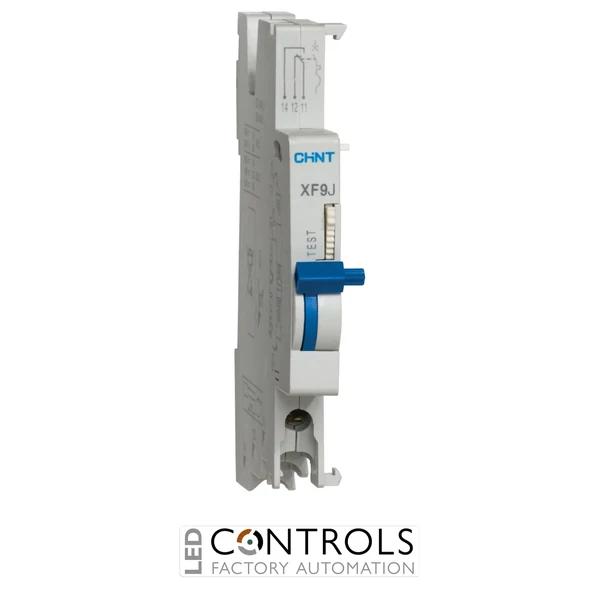
Chint XF9J alarm auxiliary contact providing remote indication following automatic overload or short-circuit trips on compatible Chint miniature circuit breakers and RCBOs.
£7.82
The Chint XF9J is a compact and dependable alarm auxiliary contact accessory designed to provide remote indication when a compatible Chint miniature circuit breaker (MCB) or RCBO trips due to an overload or short-circuit fault. Unlike a standard auxiliary contact, the XF9J is specifically intended to signal automatic fault trips, allowing rapid fault identification and improved system monitoring.
Designed for use with compatible Chint NB1, NBH8, NB1L and NBH8LE series protective devices, the XF9J mounts directly to the left-hand side of the breaker using a dedicated pin connection. Its 1 normally open and 1 normally closed contact configuration allows simple integration into alarm, monitoring and building management systems.
With a rated insulation voltage of 500 V, IP20 protection and reliable electrical performance, the XF9J is suitable for residential, commercial and industrial electrical installations where automatic fault indication is required for enhanced maintenance and operational safety.
The Chint XF9J is designed specifically to provide alarm indication after a protective device trips automatically due to an overload or short circuit. This allows operators, maintenance engineers and building management systems to distinguish genuine fault conditions from normal manual switching operations, improving troubleshooting and reducing downtime.
Its compact design, dependable switching performance and simple installation make the XF9J an ideal accessory for modern distribution boards, switchboards and industrial control panels where remote fault signalling is required.
Tick the specs you need, then view products that match.
| Device Type | Accessory | |
|---|---|---|
| Manufacturer | Chint | |
| Series | XF9J | |
| Model | XF9J | |
| Product type | Alarm auxiliary contact | |
| Function | Indicates automatic trip caused by overload or short circuit | |
| Compatible devices | NB1, NBH8, NB1L and NBH8LE series MCBs and RCBOs | |
| Contact configuration | 1 N/O + 1 N/C | |
| Rated operating voltage | 24 V DC (6 A), 48 V DC (2 A), 130 V DC (1 A) | |
| Rated insulation voltage | 500 V | |
| Rated impulse withstand voltage | 4 kV | |
| Dielectric test voltage | 2 kV | |
| Protection degree | IP20 | |
| Mechanical life | 10,000 operations | |
| Electrical life | 4,000 operations minimum | |
| Terminal capacity | 2.5 mm² | |
| Tightening torque | 0.8 N·m | |
| Mounting position | Left side of compatible MCB or RCBO | |
| Operating temperature | -5°C to +40°C | |
| Storage temperature | -25°C to +70°C | |
| Dimensions (H × W × D) | approx. 82 × 45 × 49.5 mm | |
| Standard | IEC/EN 60947-5-1 |
The Chint XF9J provides remote alarm indication when a compatible Chint circuit breaker or RCBO trips automatically due to an overload or short-circuit fault.
The XF9J indicates automatic fault trips only, whereas the standard XF9 auxiliary contact indicates the normal ON, OFF and contact position of the connected device.
The XF9J is compatible with selected Chint NB1, NBH8, NB1L and NBH8LE miniature circuit breakers and RCBOs.
The XF9J provides one normally open and one normally closed auxiliary contact (1 N/O + 1 N/C).
The XF9J mounts on the left side of a compatible Chint MCB or RCBO using the dedicated connection interface.
Chint XF9J alarm auxiliary contacts are widely used by electricians, panel builders and maintenance engineers to provide dependable remote fault indication and improve monitoring within low voltage electrical distribution systems.
We use cookies
We use essential cookies to run this site, your basket and checkout. With your permission we'd also like to use analytics and advertising cookies to understand how the site is used and to measure our adverts.