Standard delivery
£8 ex VAT · free over £200UK parcel delivery is £8 ex VAT, or free on orders over £200 ex VAT.
Heavier items may be charged at a weight-based or pallet rate, shown at checkout.
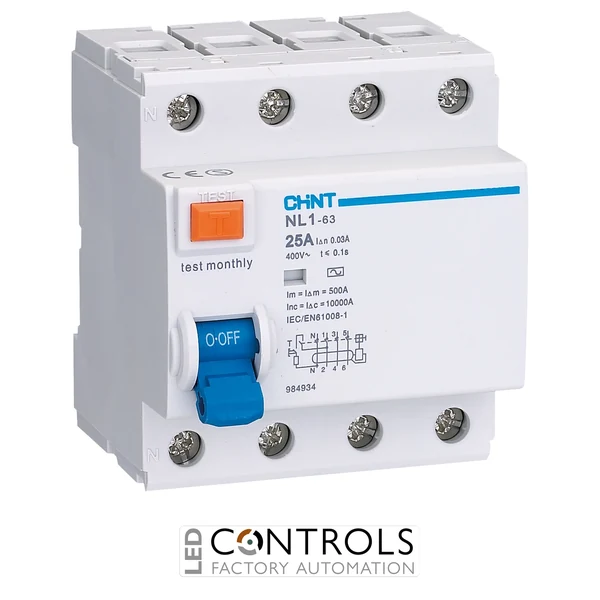
Chint NL210-63-463/30 Type B RCCB with 63A rated current, 30mA sensitivity and 4 pole 3P+N configuration for advanced residual current protection in three-phase electrical installations.
£123.59
The Chint NL210-63-463/30 is a high-performance 4 pole Type B Residual Current Device (RCD/RCCB) designed to provide advanced protection against earth leakage currents in modern commercial, industrial and three-phase electrical installations. As part of the specialist Chint NL210 series, it detects AC, pulsating DC and smooth DC residual currents, making it suitable for circuits containing power electronics and equipment that may generate DC leakage currents.
This RCCB continuously monitors residual current and disconnects the supply when a dangerous leakage fault is detected. Its Type B residual current detection makes it ideal for applications where conventional Type AC or Type A devices may not provide suitable protection, including installations with EV chargers, photovoltaic systems, variable speed drives, UPS equipment and frequency converters.
With a 63A rated current, 30mA residual operating current and 3P+N configuration, the NL210-63-463/30 provides additional personal protection for three-phase systems while delivering reliable performance in demanding electrical distribution environments.
Type B residual current devices are designed to detect a wider range of leakage currents than standard RCDs, including smooth DC residual currents that may be produced by modern power electronic equipment. This makes them essential for installations using EV chargers, solar inverters, variable speed drives, UPS systems and other converter-based loads.
The Chint NL210 range provides dependable residual current protection without integrated overcurrent protection, meaning it should be installed alongside a suitable MCB or MCCB. Its compact modular design, fast tripping performance and advanced leakage detection make it suitable for demanding three-phase electrical installations.
Tick the specs you need, then view products that match.
| Current | 40 A | |
|---|---|---|
| Phase | Three Phase | |
| Poles | 4-pole + N | |
| Device Type | RCD | |
| Residual Current | 30 mA | |
| RCD Type | Type B | |
| Manufacturer | Chint | |
| Series | NL210 | |
| Model | NL210-63-463/30 | |
| Product type | Type B Residual Current Device (RCD / RCCB) | |
| Rated current | 63A | |
| Residual operating current | 30mA | |
| Number of poles | 4 Pole / 3P+N | |
| Residual current type | Type B | |
| Rated voltage | 400/415V AC | |
| Frequency | 50Hz | |
| Rated insulation voltage | 500V | |
| Rated impulse withstand voltage | 4kV | |
| Conditional short-circuit current | 10kA | |
| Protection rating | IP20 | |
| Mounting type | 35mm DIN rail | |
| Standard | IEC/EN 62423 & IEC/EN 61008-1 |
It provides Type B residual current protection for three-phase electrical installations, particularly where equipment may generate AC, pulsating DC or smooth DC leakage currents.
A Type B RCD detects sinusoidal AC, pulsating DC and smooth DC residual currents, making it suitable for inverter-based equipment, EV charging systems and renewable energy installations.
No. The NL210-63-463/30 is an RCCB and must be used with suitable overcurrent protection such as an MCB or MCCB.
This model has a 63A rated current with a 30mA residual operating current.
It is commonly installed in EV charging systems, PV installations, industrial control panels, commercial distribution boards and three-phase switchboards.
Chint NL210 Type B Residual Current Devices are trusted by electricians, panel builders and industrial engineers for advanced earth leakage protection, dependable performance and compliance with modern electrical safety standards.
We use cookies
We use essential cookies to run this site, your basket and checkout. With your permission we'd also like to use analytics and advertising cookies to understand how the site is used and to measure our adverts.