Standard delivery
£8 ex VAT · free over £200UK parcel delivery is £8 ex VAT, or free on orders over £200 ex VAT.
Heavier items may be charged at a weight-based or pallet rate, shown at checkout.
£42.61
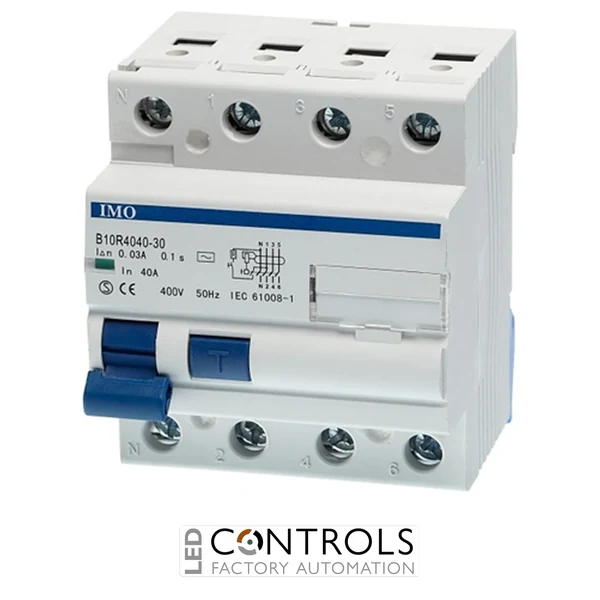
The IMO B10R4025-300 is a dependable Residual Current Circuit Breaker (RCCB) designed to protect commercial and industrial electrical installations against earth leakage faults. Manufactured by IMO Precision Controls, this four-pole device monitors the current flowing through a three-phase plus neutral circuit and disconnects the electrical supply when residual current reaches the specified operating threshold.
The B10R4025-300 combines a compact modular format with straightforward DIN rail installation, making it suitable for electrical distribution boards, machinery panels and building-services equipment. Its Type AC residual current characteristic provides detection of sinusoidal alternating earth leakage currents commonly encountered in conventional electrical loads.
With a 25 A rated current, 300 mA rated residual operating current and a four-pole configuration, the IMO B10R4025-300 is particularly suitable for three-phase installations requiring earth fault and fire-risk protection. The device is designed in accordance with IEC 61008-1 and must be used alongside suitable overcurrent protection.
An RCCB continuously compares the current flowing through the live conductors of an electrical circuit. If an imbalance indicates that current is leaking to earth, the device automatically disconnects the supply. This helps protect cables, equipment and installations from potentially hazardous earth faults.
The 300 mA residual operating threshold is commonly selected for earth fault and fire-risk protection rather than direct additional protection against electric shock. The B10R4025-300 should therefore be incorporated into a properly coordinated protection system designed in accordance with applicable wiring regulations.
Tick the specs you need, then view products that match.
| Voltage | 415 V | |
|---|---|---|
| Phase | Three Phase | |
| Poles | 4-pole | |
| Device Type | RCD | |
| Residual Current | 300 mA | |
| Manufacturer | IMO Precision Controls | |
| Series | B10R | |
| Model | B10R4025-300 | |
| Product type | Residual Current Circuit Breaker (RCCB) | |
| Rated current | 25 A | |
| Rated residual operating current | 300 mA | |
| Residual current characteristic | Type AC | |
| Number of poles | 4 | |
| Circuit configuration | Three-phase plus neutral | |
| Rated voltage | 400 V AC | |
| Rated frequency | 50/60 Hz | |
| Mounting type | DIN rail | |
| Installation position | Electrical distribution board or control panel | |
| Test facility | Integrated test button | |
| Compliance standard | IEC 61008-1 | |
| Overcurrent protection | Separate protective device required | |
| HS Code | 8536201090 | |
| Country of Manufacture | China |
It is used to detect earth leakage in three-phase plus neutral electrical circuits and disconnect the supply when the residual current reaches the device’s rated operating threshold.
The IMO B10R4025-300 has a rated current of 25 A.
This model has a rated residual operating current of 300 mA, making it suitable for earth fault and fire-risk protection applications.
Type AC means the RCCB is designed to detect sinusoidal alternating residual currents. Installations containing electronic equipment that can produce pulsating DC leakage may require a Type A or another suitable RCCB type.
No. This RCCB provides residual current protection only and must be installed with an appropriately rated fuse or circuit breaker for overload and short-circuit protection.
IMO residual current circuit breakers provide electrical contractors, panel builders and industrial engineers with dependable earth leakage protection and straightforward integration into modern electrical distribution systems.
We use cookies
We use essential cookies to run this site, your basket and checkout. With your permission we'd also like to use analytics and advertising cookies to understand how the site is used and to measure our adverts.