Standard delivery
£8 ex VAT · free over £200UK parcel delivery is £8 ex VAT, or free on orders over £200 ex VAT.
Heavier items may be charged at a weight-based or pallet rate, shown at checkout.
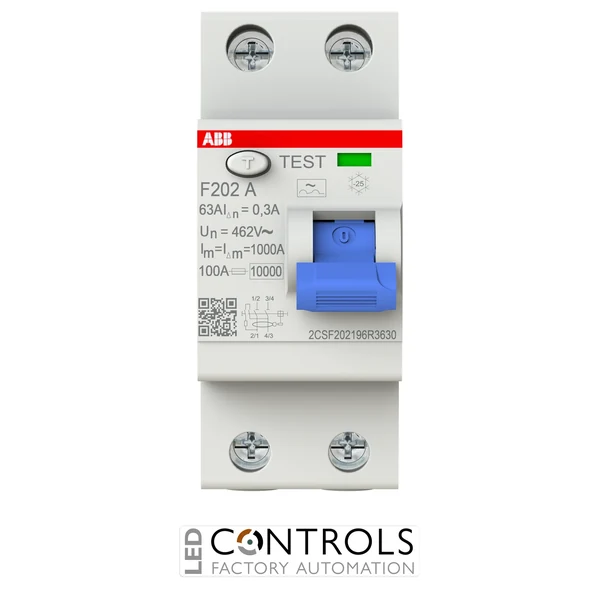
ABB F202 A-63/0.3 16-2/3Hz is a 2-pole Type A RCCB rated at 63 A and 300 mA for residual current protection in 16 2/3 Hz railway electrical applications.
£261.61
The ABB F202 A-63/0.3 16-2/3Hz is a specialised 2-pole Type A residual current circuit breaker (RCCB) designed specifically for electrical systems operating at 16 2/3 Hz, a frequency used in railway applications. Identified by ABB order code 2CSF202196R3630, it forms part of ABB's F200 range of residual current protection devices.
Rated at 63 A with a rated residual operating current of 300 mA, the F202 A-63/0.3 16-2/3Hz provides protection against the effects of sinusoidal alternating and direct pulsating earth fault currents. Its Type A characteristic enables detection of both AC and pulsating DC residual-current waveforms.
Unlike standard-frequency RCCBs, this version is specifically designed to operate at a rated frequency of 16 2/3 Hz. Its dedicated railway application, 2-pole configuration and compliance with IEC/EN 61008 standards make it a purpose-designed residual current protection solution for compatible low-frequency railway electrical systems.
Residual current protection must be matched to the electrical characteristics of the installation in which it operates. The ABB F202 A-63/0.3 16-2/3Hz is specifically engineered to work at a rated frequency of 16 2/3 Hz, making it suitable for railway applications using this low-frequency power system. It combines a 63 A current rating with a 300 mA residual current threshold.
Its Type A characteristic provides response to sinusoidal alternating and direct pulsating residual currents. The 300 mA sensitivity is not the 30 mA level used for additional protection against direct contact, so selection must reflect the required protective function and railway installation requirements. As an RCCB, it does not incorporate overload or short-circuit protection, which must be provided separately by appropriately coordinated protective devices.
| Series | F200 |
|---|---|
| ABB order code | 2CSF202196R3630 |
| Product group | F200 / FH200 RCCB |
| Product type | Residual current circuit breaker (RCCB) |
| Number of poles | 2 |
| Rated current | 63 A |
| Rated residual operating current | 300 mA |
| Residual current type | Type A |
| Rated frequency | 16 2/3 Hz |
| Residual current detection | Sinusoidal alternating and direct pulsating currents |
| Application | Railway electrical systems |
| Weight | approximately 0.200 kg |
| Pack unit | 1/6 pieces |
| Standards | IEC/EN 61008-1; IEC/EN 61008-2-1 |
The ABB F202 A-63/0.3 16-2/3Hz is a specialised 2-pole Type A RCCB designed for 16 2/3 Hz railway electrical applications, providing residual current protection with a 300 mA operating threshold.
The RCCB has a rated current of 63 A and a rated residual operating current of 300 mA.
This version of the ABB F200 RCCB is specifically designed to operate at a rated frequency of 16 2/3 Hz, a frequency used in railway electrical systems. A residual current device should be selected for the actual network frequency specified for the installation.
Type A means the RCCB responds to sinusoidal alternating residual currents and direct pulsating residual currents, providing protection against these earth-fault current waveforms.
No. The F202 A-63/0.3 16-2/3Hz is an RCCB providing residual current protection. Suitable overload and short-circuit protection must be provided separately and coordinated with the RCCB.
ABB F200 16 2/3 Hz Type A RCCBs provide purpose-designed residual current protection for railway electrical systems, combining low-frequency operation with detection of sinusoidal AC and direct pulsating earth fault currents.
We use cookies
We use essential cookies to run this site, your basket and checkout. With your permission we'd also like to use analytics and advertising cookies to understand how the site is used and to measure our adverts.