Standard delivery
£8 ex VAT · free over £200UK parcel delivery is £8 ex VAT, or free on orders over £200 ex VAT.
Heavier items may be charged at a weight-based or pallet rate, shown at checkout.
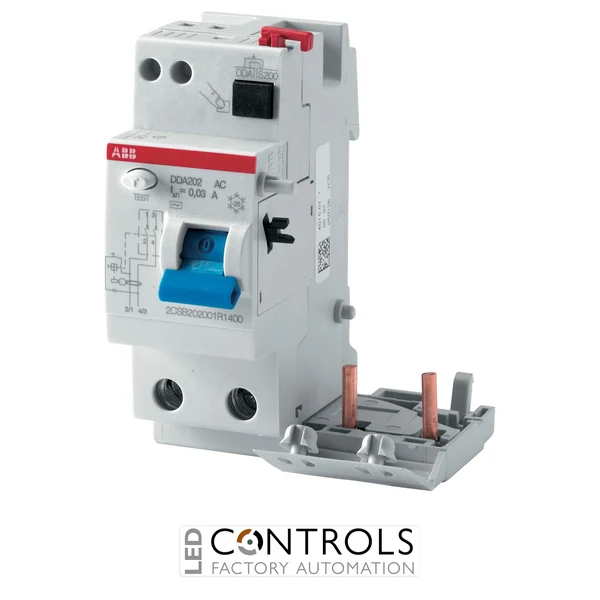
ABB DDA202 AC-63/2 is a 2-pole Type AC residual current device block rated at 63 A with 2000 mA sensitivity for assembly with compatible ABB circuit breakers.
£128.43
The ABB DDA202 AC-63/2 is a robust 2-pole Type AC residual current device (RCD) block designed to provide residual-current protection when combined with compatible ABB miniature circuit breakers. As part of the ABB DDA200 RCD series, it is intended for residential, commercial and industrial electrical installations requiring detection of sinusoidal alternating earth fault currents.
This RCD block has a 2000 mA (2 A) rated residual current, providing earth leakage protection for applications where this higher residual-current threshold is specified. Its Type AC characteristic responds to sinusoidal alternating residual currents, while the DDA200 modular architecture allows residual-current protection to be combined with the overload and short-circuit protection of a compatible ABB miniature circuit breaker.
With a rated current of 63 A, a 2-pole configuration and a rated voltage of 230/400 V AC, the DDA202 AC-63/2 is suitable for higher-current electrical distribution circuits. Its compact modular construction enables straightforward installation in electrical distribution boards and control panels requiring coordinated residual-current and overcurrent protection.
Residual current protection helps safeguard electrical installations by detecting leakage current flowing from an electrical circuit to earth. The ABB DDA202 AC-63/2 responds to sinusoidal alternating residual currents, helping reduce risks associated with insulation faults and earth leakage in electrical distribution systems.
The DDA200 system can be coupled with ABB S200 L, S200, S200 M and S200 P miniature circuit breakers to provide combined residual-current and overcurrent protection. DDA200 blocks can also be combined with compatible ABB M200 magnetic-only circuit breakers, in which case separate thermal protection against overload currents is required.
| Series | DDA200 |
|---|---|
| SKU | DDA202AC632 |
| Order code | 2CSB202001R6630 |
| Product type | Residual current device (RCD) block |
| Residual-current type | Type AC |
| Number of poles | 2 |
| Rated current | 63 A |
| Rated residual current | 2000 mA (2 A) |
| Rated voltage | 230/400 V AC |
| Rated operational voltage | 230 V AC |
| Rated frequency | 50/60 Hz |
| Rated insulation voltage | 500 V |
| Rated impulse withstand voltage | 4 kV |
| Degree of protection | IP2X |
| Power loss | 5 W |
| Standard | IEC/EN 61009 Annex G |
| Operating ambient temperature | -25 to +55 °C |
| Conductor connection capacity | up to 25 mm² |
| Dimensions (H × W × D) | 93 × 70 × 76 mm |
| Weight | approx. 0.18 kg |
The DDA202 AC-63/2 is an RCD block designed for assembly with compatible ABB circuit breakers to provide residual-current protection against earth leakage faults in electrical installations.
The ABB DDA202 AC-63/2 has a rated current of 63 A.
The device has a rated residual current of 2000 mA (2 A), making it suitable for earth leakage protection applications requiring this residual-current threshold.
It is a Type AC RCD block designed to respond to sinusoidal alternating residual currents.
The ABB DDA200 series can be combined with compatible S200 L, S200, S200 M and S200 P miniature circuit breakers. It can also be coupled with compatible M200 magnetic-only circuit breakers when appropriate additional thermal overload protection is provided.
ABB DDA200 residual current device blocks provide modular residual-current protection for residential, commercial and industrial electrical installations, combining with compatible ABB circuit breakers to create coordinated circuit protection assemblies.
We use cookies
We use essential cookies to run this site, your basket and checkout. With your permission we'd also like to use analytics and advertising cookies to understand how the site is used and to measure our adverts.