Standard delivery
£8 ex VAT · free over £200UK parcel delivery is £8 ex VAT, or free on orders over £200 ex VAT.
Heavier items may be charged at a weight-based or pallet rate, shown at checkout.
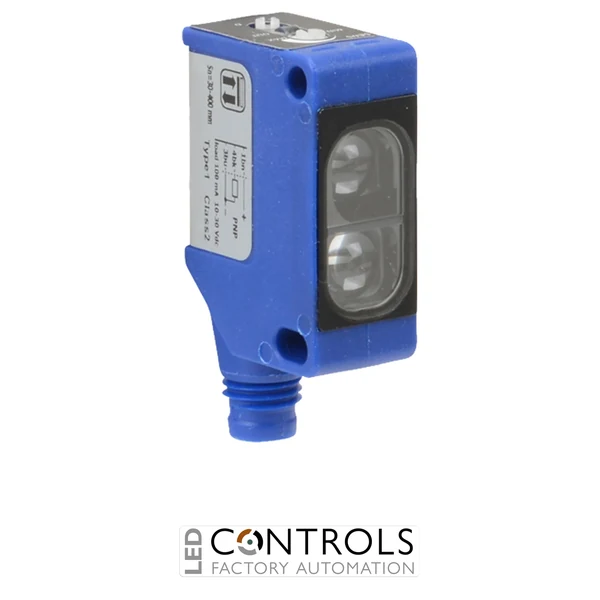
IMO QDRR/0N-0F is a compact through-beam photo-electric receiver with NPN transistor output and M8 plug connection for reliable non-contact object detection in industrial automation applications.
£52.25
The IMO QDRR/0N-0F is a compact through-beam photo-electric receiver designed for reliable non-contact object detection in industrial automation and machine-control applications. Its miniature block-style construction makes it suitable for packaging machinery, conveyors, assembly equipment and other installations where available mounting space is limited.
As the receiver element of a through-beam sensing system, the QDRR/0N-0F is installed opposite a compatible photoelectric emitter. The receiver monitors the transmitted optical beam and changes its output state when an object interrupts the sensing path, providing dependable presence, position and product detection.
The QDRR/0N-0F features an NPN transistor output and an M8 plug connection for convenient integration into industrial control systems. The detachable connector simplifies installation and sensor replacement, while the through-beam operating principle provides reliable detection independently of the target's surface reflectivity.
Through-beam photoelectric sensing uses separate transmitter and receiver devices mounted opposite one another. The emitter generates an optical beam that is monitored continuously by the QDRR/0N-0F receiver. When a product or component passes between the two sensors and interrupts the beam, the receiver changes its electronic output state.
Because detection is based primarily on interruption of the beam rather than light reflected from the target itself, through-beam sensing is well suited to applications involving objects with different colours, finishes or levels of reflectivity. The compact IMO QDRR/0N-0F combines this dependable operating principle with NPN switching and convenient M8 connectivity for industrial machinery.
Tick the specs you need, then view products that match.
| Sensing Mode | Through-beam | |
|---|---|---|
| Output Type | NPN | |
| Sensing Principle | Photoelectric - through-beam | |
| Housing Size | M8 | |
| Connection | M8 connector | |
| Manufacturer | IMO | |
| Model | QDRR/0N-0F | |
| Product type | Photo-electric switch / sensor receiver | |
| Sensing principle | Through-beam | |
| Sensor function | Receiver | |
| Output Type | NPN transistor | |
| Connection type | M8 plug | |
| Housing style | Compact block / rectangular | |
| Detection method | Non-contact optical beam interruption | |
| System configuration | Separate emitter and receiver | |
| Application | Industrial automation and machine control | |
| HS Code | 8541490000 | |
| Country of Manufacture | Italy |
The QDRR/0N-0F is a through-beam photo-electric receiver designed to detect interruption of an optical beam generated by a compatible separate emitter.
The QDRR/0N-0F is the receiver component of a through-beam photoelectric sensing system and must be paired with a compatible emitter.
The QDRR/0N-0F uses an NPN transistor output for integration with compatible industrial control and PLC inputs.
The sensor uses an M8 plug connection, providing a detachable electrical interface that simplifies installation, maintenance and replacement.
Through-beam sensing provides reliable non-contact detection by monitoring interruption of a beam between separate emitter and receiver units, making detection less dependent on the colour or reflectivity of the target.
IMO photoelectric sensors provide practical non-contact detection solutions for machine builders and automation engineers requiring compact installation, dependable optical sensing and straightforward integration with industrial control systems.
We use cookies
We use essential cookies to run this site, your basket and checkout. With your permission we'd also like to use analytics and advertising cookies to understand how the site is used and to measure our adverts.