Standard delivery
£8 ex VAT · free over £200UK parcel delivery is £8 ex VAT, or free on orders over £200 ex VAT.
Heavier items may be charged at a weight-based or pallet rate, shown at checkout.
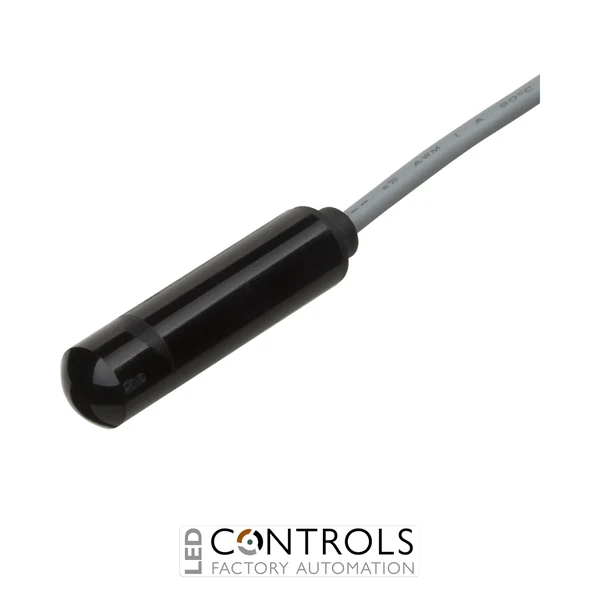
Carlo Gavazzi PB10C2T20 is a Code 2 Ø10 mm through-beam photoelectric emitter with a 20 m sensing range, 880 nm modulated infrared light, 10–30 V DC supply, 5 m cable and IP67 protection.
£40.27
The Carlo Gavazzi PB10C2T20 is a compact through-beam photoelectric emitter designed for reliable object and presence detection in industrial automation and powered access applications. As part of the Carlo Gavazzi PB10 series, this Code 2 transmitter uses modulated infrared light and operates together with a compatible receiver to create a dependable photoelectric detection beam.
With a nominal sensing range of up to 20 m, the PB10C2T20 is suitable for applications requiring detection across relatively long distances while maintaining a very compact sensor profile. The emitter uses an 880 nm infrared LED, and its cylindrical smooth-barrel housing measures just Ø10 mm, making it particularly useful where installation space is limited.
The PB10C2T20 operates from a 10–30 V DC supply and is supplied with a 5 m cable for straightforward machine wiring. Its durable plastic housing provides IP67 protection, while the emitter incorporates a mute control input and is designed as part of an ESPE Type 2 photoelectric sensing system.
Through-beam photoelectric sensing uses a separate emitter and receiver positioned opposite one another. The PB10C2T20 generates a modulated infrared beam that is detected by the corresponding receiver, allowing the control system to identify when an object interrupts the beam path.
The combination of a compact Ø10 mm housing, long sensing range and IP67 protection makes the PB10C2T20 suitable for installations where reliable detection must be achieved without bulky sensor hardware. The emitter and receiver are ordered separately, allowing the required output configuration to be selected on the matching receiver.
Tick the specs you need, then view products that match.
| Sensing Mode | Through-beam | |
|---|---|---|
| IP Rating | IP67 | |
| Sensing Principle | Photoelectric - through-beam | |
| Sensing Distance | 20000 mm | |
| Connection | Cable | |
| Manufacturer | Carlo Gavazzi | |
| Series | PB10 | |
| Model | PB10C2T20 | |
| Product type | Through-beam photoelectric emitter | |
| Sensor code | Code 2 | |
| Detection principle | Through-beam | |
| Sensing range | 20 m | |
| Rated operating voltage | 10–30 V DC | |
| Supply current | ≤20 mA | |
| Light source | LED, 880 nm | |
| Light type | Infrared, modulated | |
| Emitter angle | ±3.8° at 12 m | |
| Power-on delay | ≤100 ms | |
| Housing type | Cylindrical smooth barrel | |
| Housing diameter | Ø10 mm | |
| Housing material | Plastic | |
| Connection type | Integral cable | |
| Cable length | 5 m | |
| Protection rating | IP67 | |
| Operating temperature | -20 to +50 °C | |
| Safety system type | ESPE Type 2 | |
| Applicable standards | EN 12445, EN 12453, EN 12978, UL 325 | |
| EAN | 5709870331539 |
The PB10C2T20 is a Code 2 through-beam photoelectric emitter that generates an infrared sensing beam for detection by a compatible Carlo Gavazzi receiver.
The PB10C2T20 is designed for a nominal through-beam sensing range of up to 20 m when used with the appropriate receiver.
The emitter operates from a 10–30 V DC supply, making it suitable for common industrial DC control systems.
The PB10C2T20 uses an 880 nm modulated infrared LED as its photoelectric light source.
No. The PB10C2T20 is the emitter only; the compatible through-beam receiver is ordered separately and can be selected with the required output configuration.
The sensor is supplied with an integral 5 m cable for connection to the machine or control system.
The PB10C2T20 has an IP67 protection rating, making it suitable for demanding industrial sensing installations.
Carlo Gavazzi photoelectric sensors are used in industrial automation, machine building and access-control applications where compact installation, dependable object detection and reliable integration with control systems are required.
We use cookies
We use essential cookies to run this site, your basket and checkout. With your permission we'd also like to use analytics and advertising cookies to understand how the site is used and to measure our adverts.