Standard delivery
£8 ex VAT · free over £200UK parcel delivery is £8 ex VAT, or free on orders over £200 ex VAT.
Heavier items may be charged at a weight-based or pallet rate, shown at checkout.
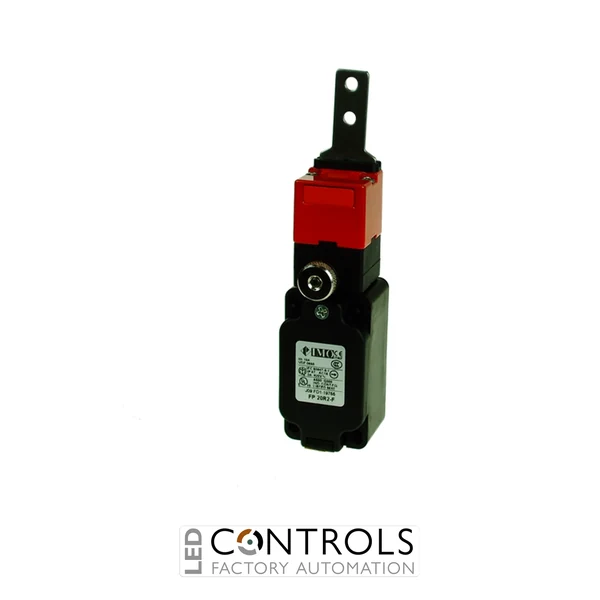
IMO LPC9R2-F20 standard door interlock limit switch with a flat actuator, 2 NC delayed-release contacts, plastic body and single M20 cable entry for industrial guard and door position monitoring.
£50.49
The IMO LPC9R2-F20 is a robust standard door interlock limit switch designed for mechanical guarding and access-door monitoring on industrial machinery. It uses a flat actuator that engages with the switch mechanism when the associated guard or door is in position, providing dependable status detection for machine control and interlocking circuits.
The LPC9R2-F20 incorporates 2 normally closed contacts with delayed release, making it specifically configured for door-interlocking applications rather than general-purpose position sensing. The two NC contacts provide two switching paths, while the delayed-release mechanism provides controlled contact operation as the actuator is withdrawn.
Housed in a durable plastic body, the LPC9R2-F20 uses a single M20 cable entry for industrial control wiring. Its combination of flat actuator, dual normally closed contacts and delayed-release operation makes it suitable for machine guards, access doors, protective covers and other industrial applications requiring mechanically actuated interlock monitoring.
Door interlock limit switches such as the IMO LPC9R2-F20 are designed to detect whether a movable machine guard, access door or protective cover is in its intended position. The flat actuator mechanically engages with the switch as the guard closes, allowing the machine control system to use the resulting contact state as part of its interlocking logic.
The LPC9R2-F20 uses two normally closed contacts with delayed-release operation. This specialised contact arrangement makes the switch suitable for applications where controlled mechanical switching is required as the actuator moves out of the interlock mechanism. The plastic enclosure and M20 cable entry provide a practical configuration for integration into industrial machinery and automated equipment.
Tick the specs you need, then view products that match.
| Device Type | Limit switch | |
|---|---|---|
| Contacts | 2NC | |
| Housing Material | Plastic | |
| Connection | M20 cable entry | |
| Manufacturer | IMO | |
| Series | LPC | |
| Model | LPC9R2-F20 | |
| Alternative SKU | LPC9R2F20 | |
| Product type | Standard door interlock limit switch | |
| Actuator type | Flat actuator | |
| Contact arrangement | 2 NC | |
| Contact operation | Delayed release | |
| Body material | Plastic | |
| Cable entry | 1 × M20 | |
| Cable entries | Single | |
| Operation | Mechanical door and guard position detection | |
| Barcode | 5056207423963 | |
| HS Code | 8536500700 | |
| Country of Manufacture | Italy |
The IMO LPC9R2-F20 is a standard door interlock limit switch designed to detect the position of machine guards, access doors, protective covers and similar movable components in industrial machinery.
The LPC9R2-F20 uses a flat actuator that mechanically engages with the interlock switch when the associated machine guard or door is in position.
The LPC9R2-F20 incorporates 2 normally closed contacts with delayed-release operation for industrial door and guard interlocking applications.
The delayed-release mechanism provides controlled contact operation as the flat actuator is withdrawn from the interlock switch, distinguishing this model from conventional general-purpose limit switches.
The LPC9R2-F20 has a single M20 cable entry for connection to industrial machine control wiring.
IMO industrial limit switches provide machine builders, automation engineers and maintenance professionals with dependable mechanical position and interlock monitoring for machine guards, access doors and industrial automation applications.
We use cookies
We use essential cookies to run this site, your basket and checkout. With your permission we'd also like to use analytics and advertising cookies to understand how the site is used and to measure our adverts.