Standard delivery
£8 ex VAT · free over £200UK parcel delivery is £8 ex VAT, or free on orders over £200 ex VAT.
Heavier items may be charged at a weight-based or pallet rate, shown at checkout.
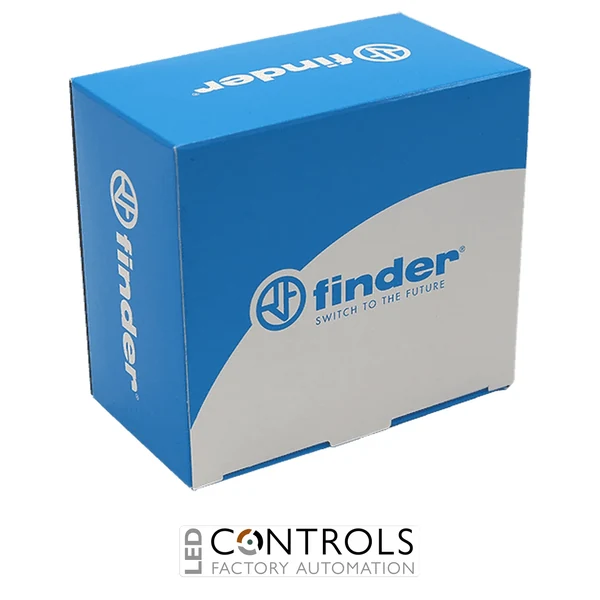
Finder 99.80.0.024.98 is a plug-in relay accessory intended for coil transient suppression in compatible low-voltage DC relay installations. The nominal application is 24 V DC. Exact socket compatibility, suppression circuit characteristics, polarity and operating limits must be confirmed against Finder technical documentation.
£3.85
The Finder 99.80.0.024.98 is a compact plug-in relay coil protection and suppression module from the Finder 99 Series. Designed for use with compatible Finder relay sockets, it provides an accessory-based solution for managing electrical transients associated with relay coil switching in industrial automation, machinery control and electrical control panel applications.
Relay coils are inductive loads. When a coil is de-energised, the collapsing magnetic field can generate a voltage transient that may affect nearby electronic equipment or place additional stress on the device controlling the relay. A correctly selected suppression module can help manage these effects and improve the electrical behaviour of the control circuit.
The Finder 99.80.0.024.98 belongs to the low-voltage DC relay accessory range and is intended for a suitable 24 V DC control application. Its plug-in construction provides a convenient alternative to installing a separate suppression component across the relay coil wiring.
For electrical panel builders, automation engineers and maintenance technicians, this type of accessory offers a practical way to incorporate coil protection into a modular relay installation. The exact suppression characteristics, connection polarity and socket compatibility must be confirmed against the manufacturer's technical documentation before installation.
Technical selection note: The exact internal circuit and full electrical ratings for part number 99.80.0.024.98 should be checked against Finder's current technical documentation before this listing is used as an installation specification. The module must not be treated as interchangeable with other 99 Series accessories solely because they share a nominal voltage.
An electromechanical relay uses a coil to create the magnetic force required to operate its switching contacts. When voltage is applied to the coil, current flows and the relay changes state. When the control voltage is removed, the magnetic field collapses and the stored energy must be dissipated.
Without suitable transient management, this stored energy can produce a relatively high voltage across the coil or the switching device controlling it. The effect can be particularly important where a relay is operated by a transistor output, a programmable logic controller or another electronic control device.
A correctly specified suppression accessory provides a controlled path or voltage-limiting mechanism for this energy. The precise behaviour depends on the internal components used in the module.
Common suppression arrangements include diodes, diode-and-Zener combinations, varistors and resistor-capacitor networks. These technologies are not electrically identical. They differ in their voltage-clamping characteristics, polarity requirements and effects on relay release time.
For that reason, engineers should confirm the actual circuit used in the Finder 99.80.0.024.98 before selecting it for a design. The appropriate suppression method must match the coil voltage, driving device and required switching response.
24 V DC is widely used in industrial control equipment, including PLC systems, machinery interfaces, sensors and auxiliary control circuits. A relay coil operating from this supply may be energised and de-energised repeatedly during normal equipment operation.
In such systems, the relay's electrical behaviour must be considered alongside the characteristics of the electronic output driving it. A suppression module can form part of the overall protection strategy.
The Finder 99.80.0.024.98 is intended for a suitable low-voltage DC relay application, but its exact operating limits must be verified. A nominal 24 V marking should not be interpreted as permission to connect the module to any supply described as 24 V without checking its permissible voltage range and electrical characteristics.
Where polarity-sensitive suppression is used, reversing the DC connections may prevent correct operation or cause an electrical fault. Installation should always follow the wiring diagram supplied for the exact module and compatible socket.
One important consideration when selecting relay coil suppression is the effect it can have on the relay's release characteristics.
Some suppression circuits allow the magnetic energy stored in the coil to decay relatively slowly. This can increase the time taken for the relay contacts to return to their de-energised position. Other suppression arrangements allow a higher transient voltage and can provide a faster release response.
The correct choice depends on the application. For example, a general-purpose auxiliary relay may have different switching requirements from a relay used in a tightly timed control sequence.
Designers should therefore check both the electrical protection requirements and the mechanical switching behaviour of the installed relay. The Finder 99.80.0.024.98 should be selected according to its verified suppression characteristics rather than nominal voltage alone.
Relay suppression accessories are not substitutes for certified safety functions, contact monitoring or protective devices required by the installation.
The modular Finder relay accessory system allows selected indication and suppression modules to be fitted to relay sockets designed with a corresponding accessory connection position.
This arrangement can simplify panel construction by locating the suppression component close to the relay coil connections. It can also make maintenance more convenient because the accessory can be identified and serviced as a separate component.
Before installing the Finder 99.80.0.024.98, confirm that the relay socket accepts this exact accessory type. Compatibility cannot be established from the Finder 99 Series designation alone, as different socket families use different accessory formats.
The electrical supply must be safely isolated before installation or removal. The module should be fitted in the correct orientation, and any polarity requirements must be followed.
After installation, the complete assembly should be checked against the relay manufacturer's specifications and the requirements of the control circuit.
Tick the specs you need, then view products that match.
| Device Type | Accessory | |
|---|---|---|
| Mounting Type | Plug-in socket | |
| Brand | Finder | |
| Part number | 99.80.0.024.98 | |
| Series | 99 Series | |
| Component type | Plug-in relay accessory | |
| Intended function | Coil transient suppression | |
| Nominal control application | 24 V DC | |
| Mounting | Compatible Finder relay socket accessory position | |
| Switching contacts | Not applicable – accessory module | |
| Relay coil | Not included | |
| Relay socket | Not included | |
| Suppression circuit topology | Confirm against the exact Finder datasheet | |
| Operating voltage tolerance | Confirm against the exact Finder datasheet | |
| Polarity requirements | Follow the manufacturer's connection diagram | |
| Compatible socket models | Confirm using Finder's accessory compatibility information | |
| LED indication | Verify against the exact product specification; do not assume an indicator is included | |
| Application | Industrial DC relay coil circuits |
The Finder 99.80.0.024.98 is a plug-in relay accessory intended for coil transient suppression in a compatible low-voltage DC relay installation. Its exact suppression characteristics should be confirmed against the manufacturer's datasheet.
No. It is a relay accessory module rather than a complete electromechanical relay. A compatible relay and socket are separate components.
The part number identifies a nominal 24 V DC accessory configuration. The full permissible voltage range and electrical requirements should be confirmed from Finder's documentation before installation.
Relay coils store magnetic energy when energised. When the coil is switched off, that energy can produce a voltage transient. A correctly selected suppression module helps manage the transient and can reduce electrical stress on the controlling circuit.
No. The module must be installed in a socket specifically designed to accept its accessory format. The exact socket compatibility should be checked using Finder's technical documentation.
No. The relay socket is a separate component and must be selected for compatibility with both the module and the intended relay.
LED indication should not be assumed from the product number alone. The exact module specification should be checked to confirm whether a visual indicator is included.
Polarity requirements depend on the module's internal suppression circuit. The manufacturer's connection diagram must be followed, particularly in DC applications.
Yes. Different suppression circuits can affect how quickly the magnetic energy in a relay coil dissipates. This may influence relay release time, so the suppression method should be selected with the application's switching requirements in mind.
It should not be connected to a 230 V AC supply unless Finder explicitly specifies that operating condition for the exact part number. A module rated for the intended supply must be selected.
It may be suitable for a compatible PLC-driven relay installation where the module's suppression characteristics meet the electrical requirements of the output and relay coil. Compatibility should be verified before use.
Confirm the complete part number, compatible relay socket, relay coil voltage, permissible operating range, suppression circuit type, polarity requirements and any required indication function.
The Finder 99.80.0.024.98 relay accessory module offers a compact approach to integrating coil transient management into compatible low-voltage DC relay installations. Designed for modular industrial control equipment, it is a useful component for panel builders, automation engineers and maintenance professionals who require a correctly matched relay suppression solution.
We use cookies
We use essential cookies to run this site, your basket and checkout. With your permission we'd also like to use analytics and advertising cookies to understand how the site is used and to measure our adverts.