Standard delivery
£8 ex VAT · free over £200UK parcel delivery is £8 ex VAT, or free on orders over £200 ex VAT.
Heavier items may be charged at a weight-based or pallet rate, shown at checkout.
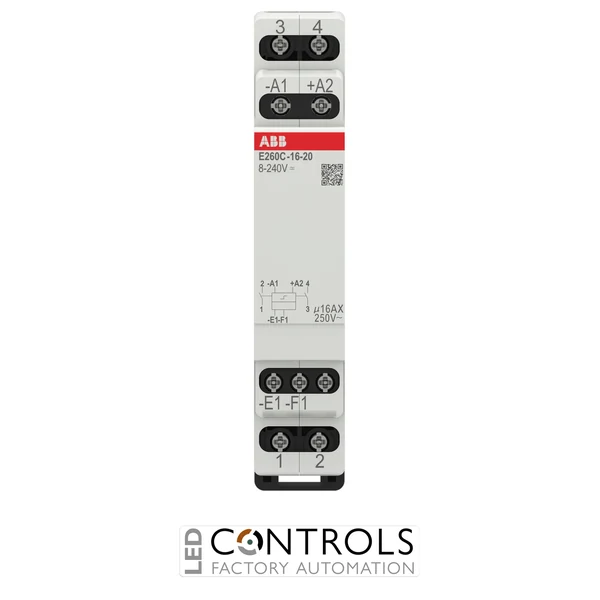
ABB E260C-16-20 is a silent electronic latching relay with two normally open contacts, a 16 A rated current, 8–240 V AC/DC universal control voltage and integrated central ON/OFF control for lighting and building-control applications.
£92.37
The ABB E260C-16-20 is a compact electronic latching relay with two normally open contacts designed for reliable and quiet switching in electrical distribution, lighting and building control systems. Its electronic operating principle provides silent switching, making it particularly suitable for installations where conventional relay operating noise is undesirable.
Featuring 2NO contacts and a rated current of 16 A, the E260C-16-20 operates at a rated voltage of 250 V AC, 50/60 Hz. Its wide 8–240 V AC/DC universal control-voltage range allows the relay to integrate with a broad variety of electrical control systems.
The E260C version incorporates an integrated central ON/OFF control function, allowing central switching commands in addition to local impulse control. Its compact one-module DIN rail format and suitability for switching LED loads up to 200 W at 230 V make it a versatile solution for modern lighting and building-control applications.
Electronic latching relays change and retain their switching state in response to control impulses, allowing electrical loads to be operated from multiple pushbutton locations without requiring continuous control energisation. The ABB E260 range combines this functionality with electronic technology for reliable, long-life and silent switching.
The E260C-16-20 adds an integrated central ON/OFF control function to local impulse operation, allowing groups of circuits to receive central switching commands while retaining decentralised control. Its two normally open contacts also provide additional switching flexibility for lighting, building automation and electrical distribution applications.
Tick the specs you need, then view products that match.
| Device Type | Latching / Impulse Relay | |
|---|---|---|
| Mounting Type | DIN rail | |
| Switching Current (A) | 16 A | |
| Series | E260C / E260 | |
| ABB order code | 2CCG000974R0001 | |
| EAN | 7612271514730 | |
| Product type | Electronic latching relay | |
| Contact configuration | 2NO | |
| Normally open contacts | 2 | |
| Rated current | 16 A | |
| Rated voltage | 250 V AC | |
| Rated frequency | 50 / 60 Hz | |
| Control voltage | 8–240 V AC/DC | |
| Central control function | Integrated ON/OFF | |
| LED load | up to 200 W at 230 V | |
| LED load at 110 V | up to 100 W | |
| Incandescent lamp load | up to 4000 W | |
| Electronic ballast load | up to 500 VA | |
| Halogen lamp load | up to 1000 VA | |
| Module width | 1 module | |
| Mounting | DIN rail | |
| Standards | IEC/EN 60669-1, IEC/EN 60669-2-1 |
The E260C-16-20 is an electronic latching relay used for impulse-operated switching in lighting, electrical distribution and building-control applications, with an integrated central ON/OFF control function.
The E260C-16-20 has two normally open (2NO) contacts and a rated current of 16 A.
The relay supports a wide universal control-voltage range of 8–240 V AC/DC, allowing it to operate with many common control-voltage systems.
Yes. The E260C-16-20 incorporates an integrated central ON/OFF control function in addition to local impulse control.
Yes. The E260C-16-20 is suitable for LED loads up to 200 W at 230 V, making it suitable for compatible modern lighting-control applications.
ABB E260 electronic latching relays provide reliable and silent impulse switching with a wide universal control-voltage range, while E260C models add integrated central ON/OFF control for flexible lighting and building automation applications.
We use cookies
We use essential cookies to run this site, your basket and checkout. With your permission we'd also like to use analytics and advertising cookies to understand how the site is used and to measure our adverts.