Standard delivery
£8 ex VAT · free over £200UK parcel delivery is £8 ex VAT, or free on orders over £200 ex VAT.
Heavier items may be charged at a weight-based or pallet rate, shown at checkout.
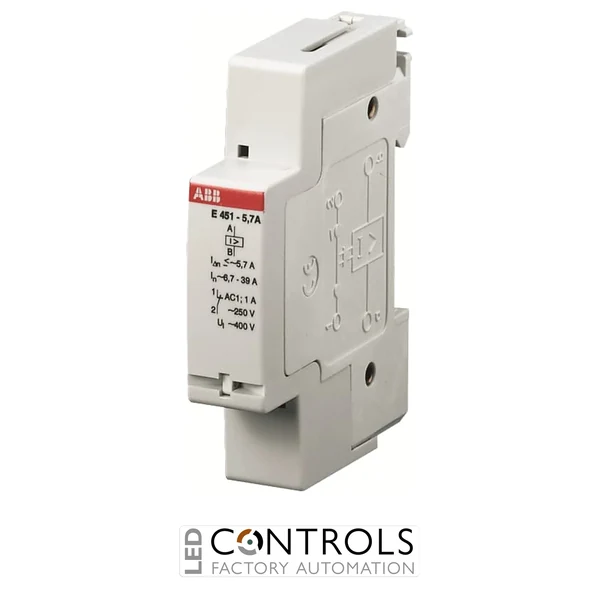
ABB E452-5.7A is an electronic priority switch with a 7–39 A measuring range, 230 V AC rated voltage and one normally closed contact for automatic load shedding and priority control of high-power electrical consumers.
£28.53
The ABB E452-5.7A is an electronic priority switch / load-shedding relay designed for installations where the available supply capacity or conductor sizing does not permit two high-power electrical loads to operate simultaneously. Part of ABB's E450 priority switch range, it automatically gives priority to a selected short-term load while temporarily disconnecting a lower-priority long-term load.
The E452-5.7A monitors the current drawn by the priority load through a current coil connected in series with that consumer. When the monitored load is switched on and the operating threshold is reached, the device opens its normally closed output contact, which can be used to release a contactor controlling the lower-priority load. When demand from the priority consumer ends, the lower-priority circuit can be restored automatically.
With a 7–39 A measuring range, 230 V AC rated voltage, 43 A continuous operating current and a compact single-module DIN-rail format, the E452-5.7A provides a practical solution for automatic load management in residential, commercial and building-services installations.
Priority switches are particularly useful where two powerful consumers cannot operate simultaneously without exceeding the capacity of the electrical installation. A common example is an installation containing a long-duration load such as storage heating and a short-duration priority load such as an instantaneous water heater. The E452-5.7A detects operation of the priority consumer and uses its normally closed contact to interrupt the control circuit of the lower-priority load.
Once demand from the priority consumer ends, the controlled load can be made available again without manual intervention. This automatic load-management approach can help an installation operate within the available supply capacity without requiring both high-power consumers to be permanently supplied at the same time.
Tick the specs you need, then view products that match.
| Product Series | ABB Modular | |
|---|---|---|
| Device Type | Accessory | |
| Series | E450 | |
| ABB order code | 2CDE160010R0901 | |
| Product group | Protection & Control | |
| Product type | Priority switch / load-shedding relay | |
| Technology | Electronic | |
| Rated voltage | 230 V AC | |
| Input voltage type | AC | |
| Measuring range | 7–39 A | |
| Continuous operating current | 43 A | |
| Maximum switching voltage | 400 V | |
| Maximum switching power | 230 W | |
| Power loss | 2.4 W | |
| Normally closed contacts | 1 | |
| Maximum switch-off delay | 20 ms | |
| Protection rating | IP40 | |
| Module width | 1 module | |
| Installation depth | 60 mm | |
| Mounting type | DIN rail | |
| Net weight | approx. 0.089 kg | |
| Country of origin | Czech Republic | |
| EAN | 4016779209502 |
The E452-5.7A is an electronic priority switch used to prevent two high-power electrical consumers from operating simultaneously by temporarily disconnecting a lower-priority load when the priority load is operating.
The ABB E452-5.7A has a 7–39 A measuring range for detecting current drawn by the monitored priority consumer.
The current-monitoring circuit is connected in series with the priority consumer. When that consumer operates, the E452-5.7A opens its normally closed contact, which can disconnect the contactor controlling the lower-priority load.
The E452-5.7A has a 230 V AC rated voltage and a maximum switching voltage of 400 V.
The E452-5.7A is designed for DIN-rail installation in distribution boards and similar electrical assemblies where automatic priority control and load shedding are required.
ABB E450 priority switches provide automatic load management for electrical installations with limited available supply capacity, allowing high-power consumers to be prioritised without relying on manual switching.
We use cookies
We use essential cookies to run this site, your basket and checkout. With your permission we'd also like to use analytics and advertising cookies to understand how the site is used and to measure our adverts.