Standard delivery
£8 ex VAT · free over £200UK parcel delivery is £8 ex VAT, or free on orders over £200 ex VAT.
Heavier items may be charged at a weight-based or pallet rate, shown at checkout.
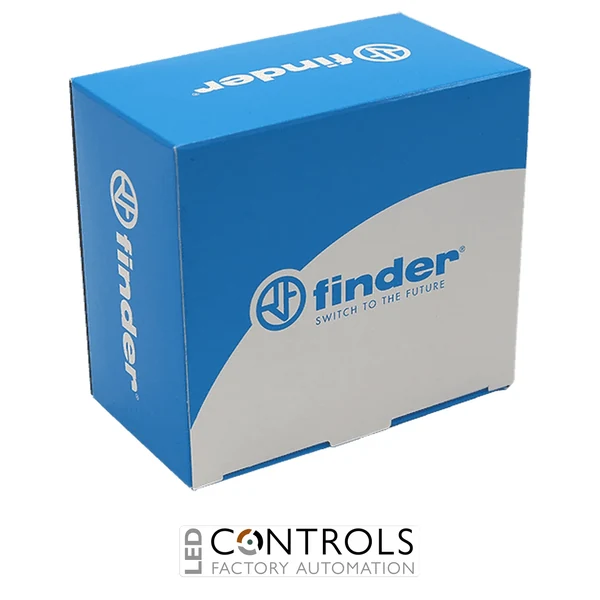
Finder 22.21.8.240.4000 20 A modular contactor with one normally open contact, 240 V AC operating coil, AgSnO2 contact material, 17.5 mm DIN rail housing and IP20 protection for suitable lighting, heating and electrical control applications.
£20.11
The Finder 22.21.8.240.4000 is a compact 20 A modular contactor with a 240 V AC operating coil, designed for switching electrical loads in distribution boards, control panels and building automation installations. Part of the Finder 22 Series, this single-pole installation contactor provides a dependable way to control lighting, heating and other suitable electrical circuits using a separate control signal.
Featuring one normally open contact (1 NO / SPST-NO), the Finder 22.21.8.240.4000 closes its output circuit when the operating coil is energised and opens it when the coil supply is removed. Its 20 A rated contact current makes it suitable for a variety of applications, provided the connected load remains within the manufacturer's relevant switching ratings.
The contactor incorporates silver tin oxide (AgSnO₂) contacts, a contact material selected for reliable electrical switching, including applications involving lighting loads and elevated inrush currents. Its compact 17.5 mm module width occupies approximately one standard DIN rail module, helping installers make efficient use of limited distribution board space.
Designed for mounting on a 35 mm DIN rail, the Finder 22.21.8.240.4000 combines straightforward installation, conventional electromagnetic operation and a compact modular format. It is particularly suitable for electricians, panel builders, maintenance engineers and building automation specialists requiring a single-pole contactor with a 240 V AC control coil.
The Finder 22.21.8.240.4000 uses an electromagnetic operating mechanism to open and close its output contact.
When the rated 240 V AC control voltage is applied to the coil terminals, the resulting magnetic field operates the internal switching mechanism and closes the normally open contact.
Closing the contact completes the connected load circuit, allowing current to flow through the controlled equipment.
When the coil supply is removed, the electromagnetic force disappears and the contact returns to its normal open position. This disconnects the load circuit.
The contactor is therefore described as monostable: it has one stable resting position and requires an energised coil to maintain its operated state.
This behaviour makes the device suitable for applications where an electrical load must operate only while a control signal is present.
For example, a time switch may energise the contactor coil during scheduled hours, allowing the contactor to switch a suitable lighting circuit. When the timer removes the control signal, the contactor opens and the lighting switches off.
Unlike a latching relay, the Finder 22.21.8.240.4000 does not retain its switched state after the operating coil has been de-energised.
The Finder 22.21.8.240.4000 has one normally open contact rated at 20 A, with a rated contact voltage of 250 V AC.
The manufacturer's Series 22 technical data also identifies a maximum switching voltage of 400 V AC and an AC-1 rated load of 5000 VA for the Type 22.21 contact arrangement.
The AC-1 rating applies to suitable non-inductive or slightly inductive loads. Other load types may have substantially different switching requirements.
For example, lighting drivers, fluorescent ballasts, motors and transformers can produce high starting or inrush currents that exceed their normal running current.
For this reason, the 20 A contact rating should not be interpreted as permission to connect any 20 A load without checking the relevant load category.
Where the contactor is used to control inductive equipment or equipment with a significant starting current, the connected load must be assessed against the applicable manufacturer ratings.
The electrical installation must also incorporate appropriate overcurrent protection and correctly sized conductors.
The Finder 22.21.8.240.4000 uses silver tin oxide (AgSnO₂) contact material.
AgSnO₂ is commonly selected for electrical switching applications where contacts may be exposed to significant current transients, including certain lighting loads.
Compared with some conventional contact materials, silver tin oxide can provide improved resistance to contact welding under appropriate switching conditions.
This makes it useful for modular contactors installed in building electrical systems, where the connected loads may include lamps, lighting control equipment and other devices with challenging switching characteristics.
However, contact material alone does not determine whether a particular load is suitable.
The complete switching arrangement must be checked against the contactor's electrical ratings, expected operating frequency and the characteristics of the connected equipment.
The Finder 22 Series is widely used for electrical load switching in building installations, including lighting control.
For the Type 22.21 contact arrangement, the manufacturer's technical data specifies representative lamp-load ratings including:
These figures illustrate why different lamp technologies must be considered separately when selecting a contactor.
A lighting circuit containing electronic LED drivers may have a relatively low normal operating current but a much higher instantaneous inrush current when energised.
The number of luminaires that can be switched safely therefore depends on more than their combined wattage.
Installers should consult the LED driver manufacturer's inrush current data and Finder's current load compatibility information before finalising the design.
For large lighting installations, dividing the load across multiple appropriately rated contactors may provide a more suitable arrangement than placing every luminaire on one switching contact.
The 22.21.8.240.4000 version is equipped with a 240 V AC operating coil.
This makes it suitable for control systems designed to provide a compatible 240 V AC switching signal.
The coil may be controlled by suitable devices such as:
The controlling device must be rated to switch the contactor coil correctly.
It is important to distinguish between the 240 V AC coil supply and the electrical rating of the main contact.
The coil voltage determines the signal required to operate the contactor, while the contact ratings determine which load circuits can be switched.
The coil should not be connected to a 24 V control circuit or another incompatible voltage.
Where a different control voltage is required, an alternative Finder 22.21 variant should be selected.
The Finder 22.21.8.240.4000 is designed for mounting on a standard 35 mm DIN rail in accordance with EN 60715.
Its 17.5 mm width occupies approximately one modular spacing, making it particularly suitable for compact distribution boards and control panels.
Compared with larger contactors, the narrow housing helps conserve panel space where only one normally open switching contact is required.
The approximate overall dimensions are 84 × 58.4 × 17.5 mm.
The device uses screw terminals for electrical connections and has an IP20 protection rating.
Although the enclosure provides protection against certain forms of accidental contact, the contactor must still be installed within a suitable electrical distribution board or control enclosure.
Its compact design is especially useful for residential and commercial installations where several modular control devices must share the available DIN rail space.
The Finder 22.21.8.240.4000 can be used as a switching component within a wider electrical control system.
Because the coil and main contact perform different functions, a relatively simple control arrangement can operate a separate electrical load circuit.
For example, an appropriately rated timer can control the coil while the contactor switches a suitable lighting load.
Similarly, a compatible building automation output may energise the contactor when a programmed condition is satisfied.
This makes the device useful in applications where the controller's own switching contacts are not intended to carry the full load current.
The contactor does not contain an integrated timer, occupancy sensor, programmable controller or wireless communication interface.
Those functions must be provided by separate compatible control equipment.
For applications requiring several independently switched circuits, additional contactors or a suitable multi-pole Finder 22 Series device may be required.
The Finder 22.21.8.240.4000 should be installed on a suitable 35 mm DIN rail within an electrical enclosure.
Before installation, the electrician should confirm that the available control supply is compatible with the 240 V AC coil.
The connected load must also be assessed against the contactor's rated current, contact voltage and relevant utilisation category.
The device provides one normally open contact, so it is intended for single-pole switching. It should not be selected where two-pole isolation or simultaneous switching of multiple conductors is required.
Electrical connections must be made using the manufacturer's terminal identification and wiring diagram.
The contactor's screw terminals should be tightened according to the current installation instructions, with conductors selected to suit the circuit current and protective device.
Finder specifies an operating ambient temperature range of -40 to +40 °C for the relevant Type 22.21 technical data.
Panel designers should consider internal enclosure temperature, ventilation, adjacent equipment and any applicable installation derating requirements.
Installation, inspection and maintenance must be performed by a competent electrician with all relevant supplies safely isolated.
The Finder 22 Series includes modular contactors with different coil voltages, contact arrangements and housing widths.
The Finder 22.21.8.240.4000 is specifically identified by its:
Other Finder 22.21 versions are available with different coil voltage ratings, including 24 V AC and 230 V AC variants.
Although the devices may appear similar, their coil voltages are not interchangeable.
When replacing an existing contactor, the complete manufacturer part number, coil supply, contact arrangement and load rating must be checked.
Where a normally closed contact, a changeover contact or more than one pole is required, a different Finder 22 Series configuration should be selected.
Tick the specs you need, then view products that match.
| Device Type | Modular contactor | |
|---|---|---|
| Coil Type | AC | |
| Coil Voltage Range | 200–250 V | |
| Manufacturer | Finder | |
| Product series | Finder 22 Series | |
| Type | 22.21 | |
| Manufacturer part number | 22.21.8.240.4000 | |
| Product category | Modular contactors and installation relays | |
| Switching technology | Electromagnetic | |
| Number of contacts | 1 | |
| Contact configuration | 1 NO / SPST-NO / Form A | |
| Normally open contacts | 1 | |
| Rated contact current | 20 A | |
| Maximum peak current | 30 A | |
| Rated contact voltage | 250 V AC | |
| Maximum switching voltage | 400 V AC | |
| Rated load AC-1 | 5000 VA | |
| Rated load AC-15 at 230 V AC | 1000 VA | |
| Nominal incandescent and halogen lamp load at 230 V AC | 1000 W | |
| Nominal fluorescent lamp load with electronic ballast | 400 W | |
| Nominal fluorescent lamp load with electromechanical ballast | 360 W | |
| Nominal compact fluorescent lamp load | 200 W | |
| Nominal 230 V LED lamp load | 200 W | |
| Contact material | AgSnO₂ (silver tin oxide) | |
| Rated coil voltage | 240 V AC | |
| Coil supply type | AC | |
| Operating principle | Monostable electromagnetic switching | |
| Approximate operate time | 15 ms | |
| Approximate release time | 8 ms | |
| Coil duty | Continuous | |
| Mounting method | 35 mm DIN rail, EN 60715 | |
| Module width | 17.5 mm | |
| Approximate dimensions | 84 × 58.4 × 17.5 mm | |
| Electrical connections | Screw terminals | |
| Protection rating | IP20 | |
| Operating ambient temperature | -40 to +40 °C | |
| EAN / GTIN | 8012823273914 |
The Finder 22.21.8.240.4000 is a 20 A modular contactor used to switch suitable electrical loads in distribution boards and control panels. It has one normally open contact, a 240 V AC operating coil and a compact 17.5 mm DIN rail housing. Typical applications include lighting, heating and building automation control circuits.
The Finder 22.21.8.240.4000 requires a 240 V AC operating coil supply. The coil must be energised with a compatible control voltage to close the normally open contact. The coil voltage is separate from the electrical rating of the switched load circuit.
The Finder 22.21.8.240.4000 has one normally open contact (1 NO / SPST-NO) rated at 20 A. The contact closes when the coil is energised and opens when the coil is de-energised. It does not provide a normally closed or changeover contact.
Yes, the Finder 22.21.8.240.4000 can switch compatible LED lighting loads. The relevant Type 22.21 technical data specifies a nominal 230 V LED lamp-load rating of 200 W. The permissible number of LED drivers depends on their inrush current and switching characteristics, so compatibility must be checked before installation.
The Finder 22.21.8.240.4000 is designed for mounting on a 35 mm DIN rail inside a suitable electrical enclosure. Its 17.5 mm width occupies approximately one standard modular spacing. The contactor uses screw terminals and has an IP20 protection rating.
The Finder 22.21.8.240.4000 modular contactor combines a 20 A normally open contact, 240 V AC operating coil and durable AgSnO₂ contact material in a space-saving 17.5 mm DIN rail housing. Ideal for suitable lighting, heating and auxiliary electrical switching applications, it provides a compact and practical solution for residential, commercial and control panel installations.
We use cookies
We use essential cookies to run this site, your basket and checkout. With your permission we'd also like to use analytics and advertising cookies to understand how the site is used and to measure our adverts.