Standard delivery
£8 ex VAT · free over £200UK parcel delivery is £8 ex VAT, or free on orders over £200 ex VAT.
Heavier items may be charged at a weight-based or pallet rate, shown at checkout.
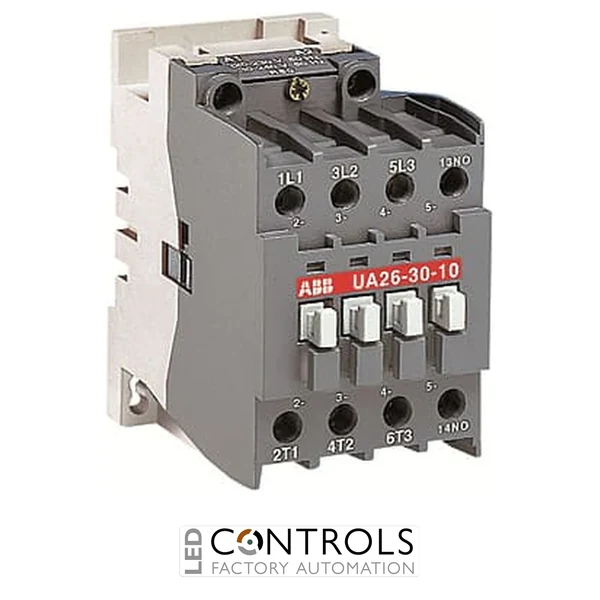
ABB UA26-30-10-86 1SBL241022R8610 is a 3-pole capacitor switching contactor with one normally open auxiliary contact, a 20 kVAr AC-6b rating at 400–415 V and a 400–415 V 50 Hz / 415–440 V 60 Hz AC coil.
£87.72
The ABB UA26-30-10-86, product ID 1SBL241022R8610, is a 3-pole capacitor switching contactor designed for controlling capacitor banks in industrial power factor correction systems. As part of the ABB UA contactor range, it is specifically designed for capacitor switching applications where inrush current peaks are less than or equal to 100 times the nominal RMS current.
The UA26-30-10-86 features three main poles and one built-in normally open auxiliary contact. Under AC-6b duty, it is rated for capacitor banks up to 20 kvar at 400–415 V at an ambient temperature of 40 °C. The capacitors must be discharged to a residual terminal voltage of no more than 50 V before being re-energised.
Its AC-operated laminated magnet circuit uses a 400–415 V AC coil at 50 Hz or 415–440 V AC at 60 Hz. The block-type construction, screw terminals and compact 90 × 54 × 93.6 mm dimensions make the UA26-30-10-86 suitable for installation within power factor correction panels and other industrial capacitor switching assemblies.
Capacitor switching places demanding electrical stresses on contactors because energising a capacitor bank can produce high transient inrush currents. The ABB UA26-30-10-86 is specifically designed for switching capacitor banks where the peak inrush current does not exceed 100 times the nominal RMS current, providing a dedicated solution for industrial power factor correction systems.
When used under the specified operating conditions, the capacitors must be discharged before they are re-energised, with a maximum residual voltage of 50 V at their terminals. Under these conditions, the UA26-30-10-86 is designed for an electrical durability of 100,000 operating cycles.
Tick the specs you need, then view products that match.
| Terminal Type | Screw | |
|---|---|---|
| Poles | 3-pole | |
| Coil Voltage Range | 380–440 V | |
| Device Type | Capacitor Switching Contactor | |
| Auxiliary Contacts | 1NO | |
| Coil Type | AC | |
| Manufacturer | ABB | |
| Series | UA | |
| Model | UA26-30-10-86 | |
| Product ID | 1SBL241022R8610 | |
| Product type | 3-pole capacitor switching contactor | |
| Number of main poles | 3 | |
| Auxiliary contacts | 1 NO | |
| Control voltage at 50 Hz | 400–415 V AC | |
| Control voltage at 60 Hz | 415–440 V AC | |
| AC-6b rated operational power | 20 kvar at 400–415 V and 40 °C | |
| Rated operational voltage | 690 V | |
| Rated impulse withstand voltage | 8 kV | |
| Maximum residual capacitor voltage before re-energisation | 50 V | |
| Electrical durability | 100,000 operating cycles under specified capacitor switching conditions | |
| Protection rating | IP20 at auxiliary terminals | |
| Terminal type | Screw terminals | |
| Operating ambient temperature at rated control voltage | -40 to +70 °C | |
| Storage temperature | -60 to +80 °C | |
| Dimensions (H × W × D) | 90 × 54 × 93.6 mm | |
| Net weight | 0.6 kg |
The ABB UA26-30-10-86 is a 3-pole contactor designed for switching capacitor banks, particularly in industrial power factor correction and reactive power compensation systems.
The UA26-30-10-86 has an AC-6b rated operational power of 20 kvar at 400–415 V at an ambient temperature of 40 °C.
The contactor uses a 400–415 V AC coil at 50 Hz or 415–440 V AC at 60 Hz.
The UA26-30-10-86 has one built-in normally open auxiliary contact for signalling and control functions.
Yes. The capacitors must be discharged to a residual terminal voltage of no more than 50 V before being re-energised by the contactor.
ABB UA contactors are designed specifically for capacitor switching applications, providing dependable control of capacitor banks and supporting industrial power factor correction systems where high switching inrush currents must be managed reliably.
We use cookies
We use essential cookies to run this site, your basket and checkout. With your permission we'd also like to use analytics and advertising cookies to understand how the site is used and to measure our adverts.