Standard delivery
£8 ex VAT · free over £200UK parcel delivery is £8 ex VAT, or free on orders over £200 ex VAT.
Heavier items may be charged at a weight-based or pallet rate, shown at checkout.
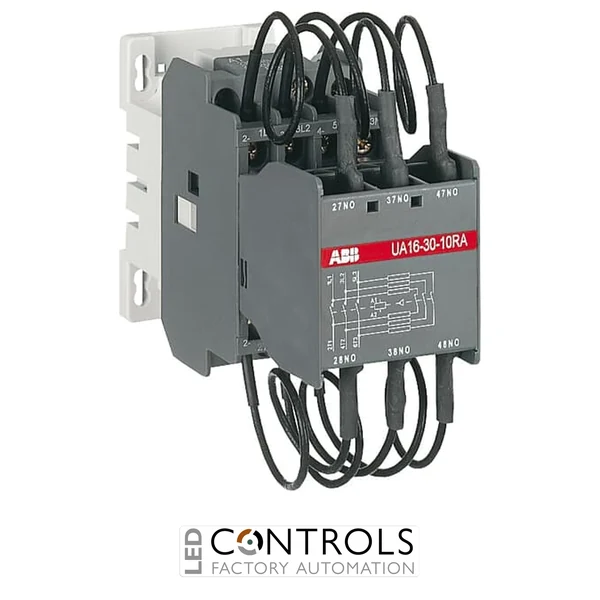
ABB UA16-30-10RA is a three-pole AC-6b capacitor-switching contactor rated at 12.5 kvar at 400–415 V AC, with damping resistors, a 400–415 V AC 50 Hz or 415–440 V AC 60 Hz coil and one normally open auxiliary contact.
£87.22
The ABB UA16-30-10RA, order code 1SBL181024R8610, is a specialised three-pole capacitor-switching contactor with damping resistors designed for power factor correction installations where capacitor-bank inrush current can greatly exceed 100 times the nominal RMS current. As part of the established ABB UA..RA contactor range, it provides reliable AC-6b switching for demanding reactive-power compensation systems.
The contactor uses early-make auxiliary poles connected to damping resistors to limit the initial current peak when a capacitor stage is energised. After the inrush current has been reduced, the main contacts close and the resistor circuit is isolated, helping protect the main contacts and associated capacitor-bank equipment from excessive switching stress.
With a capacitor-switching capacity of 12.5 kvar at 400–415 V AC and a coil rated for 400–415 V AC at 50 Hz or 415–440 V AC at 60 Hz, the UA16-30-10RA is suitable for automatic power factor correction panels and industrial capacitor banks. Its three normally open main contacts, built-in normally open auxiliary contact and screw terminals support dependable control-panel integration.
Capacitor banks can draw extremely high transient currents when energised, particularly when a correction stage is connected in parallel with capacitors that are already charged. The ABB UA16-30-10RA limits this initial current through its early-make resistor circuit before transferring the load to the main contacts.
The capacitors must be discharged before reconnection, with a maximum residual voltage of 50 V across their terminals. The contactor is designed for capacitor switching without additional inductances, making it suitable for automatic correction panels configured in accordance with ABB’s application requirements.
Tick the specs you need, then view products that match.
| Terminal Type | Screw | |
|---|---|---|
| Poles | 3-pole | |
| Coil Voltage Range | 380–440 V | |
| Device Type | Capacitor Switching Contactor | |
| Auxiliary Contacts | 1NO | |
| Coil Type | AC | |
| Manufacturer | ABB | |
| Series | UA..RA Capacitor Contactors | |
| Model | UA16-30-10RA | |
| Order code | 1SBL181024R8610 | |
| Product type | Capacitor-switching contactor with damping resistors | |
| Utilisation category | AC-6b | |
| Main contacts | 3 NO | |
| Auxiliary contacts | 1 NO | |
| Rated operational power at 230–240 V | 8 kvar at 40 °C | |
| Rated operational power at 400–415 V | 12.5 kvar at 40 °C | |
| Rated operational power at 440 V | 15 kvar at 40 °C | |
| Rated operational power at 500–550 V | 18 kvar at 40 °C | |
| Rated operational power at 690 V | 22 kvar at 40 °C | |
| Rated operational voltage | Up to 690 V AC | |
| Rated control voltage at 50 Hz | 400–415 V AC | |
| Rated control voltage at 60 Hz | 415–440 V AC | |
| Inrush-current control | Early-make auxiliary poles with damping resistors | |
| Connection type | Screw terminals | |
| Weight | 0.460 kg |
This contactor switches capacitor banks in power factor correction systems where the peak energisation current can greatly exceed 100 times the nominal RMS current.
The UA16-30-10RA is rated for 12.5 kvar at 400–415 V AC and 40 °C.
Early-make auxiliary poles initially connect the capacitor bank through damping resistors before the three main contacts close and carry the load.
Its coil is rated for 400–415 V AC at 50 Hz or 415–440 V AC at 60 Hz.
Yes. ABB specifies that the capacitors must be discharged to a maximum residual terminal voltage of 50 V before they are re-energised.
ABB UA..RA capacitor contactors provide controlled inrush-current switching for panel builders, electrical engineers and industrial operators developing dependable power factor correction systems.
We use cookies
We use essential cookies to run this site, your basket and checkout. With your permission we'd also like to use analytics and advertising cookies to understand how the site is used and to measure our adverts.