Standard delivery
£8 ex VAT · free over £200UK parcel delivery is £8 ex VAT, or free on orders over £200 ex VAT.
Heavier items may be charged at a weight-based or pallet rate, shown at checkout.
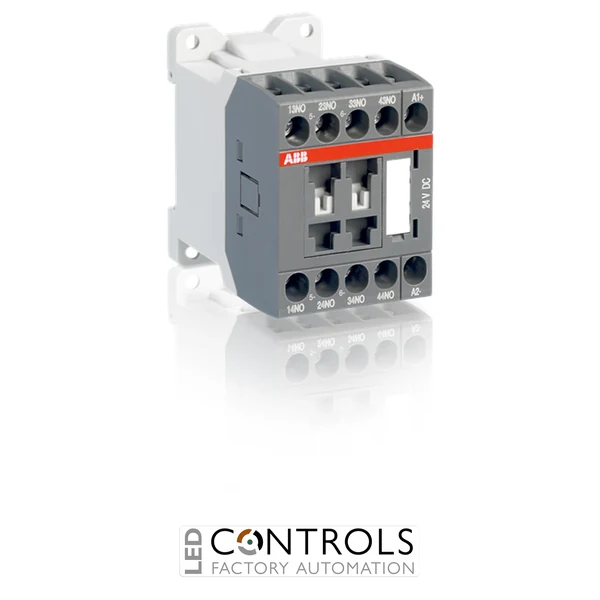
ABB NSL22E-81 is a four-pole contactor relay with a low-consumption 24 V DC coil and 2 NO + 2 NC mechanically linked contacts for industrial auxiliary and control circuits.
£26.05
The ABB NSL22E-81, product code 1SBH103001R8122, is a compact and highly reliable DC-operated contactor relay designed for switching auxiliary and control circuits in industrial automation systems. Its four-pole configuration provides 2 normally open and 2 normally closed contacts, supporting control logic, signalling and electrical interlocking functions.
Part of the ABB NSL contactor relay series, the NSL22E-81 features a low-consumption DC coil suitable for direct control from compatible PLC outputs. Its solid-core magnetic circuit provides dependable operation, while mechanically linked auxiliary contacts support safety-related control-circuit designs in accordance with the applicable requirements of IEC 60947-5-1.
With a 24 V DC operating coil, a conventional free-air thermal current of 10 A and an AC-15 operational current of 4 A at 220–240 V AC, the NSL22E-81 is suitable for controlling contactor coils, interlocks, alarms and other auxiliary loads. Its 45 mm-wide design enables space-efficient DIN rail or panel installation.
DC-operated contactor relays such as the ABB NSL22E-81 use an electromagnetic coil to switch several auxiliary contacts simultaneously. This enables a PLC or other control device to operate interlocks, status circuits, alarms and contactor coils through one dependable switching component.
The NSL22E-81 uses a low-consumption coil and requires the specified polarity at its A1+ and A2− terminals. Its mechanically linked contacts, robust industrial temperature range and compact construction make it well suited to modern automation panels and safety-conscious control-system designs.
Tick the specs you need, then view products that match.
| Terminal Type | Screw | |
|---|---|---|
| Coil Voltage Range | 24 V | |
| Poles | 4-pole | |
| Device Type | Contactor relay | |
| Current AC-1 | 10 A | |
| Manufacturer | ABB | |
| Series | NSL Contactor Relays | |
| Model | NSL22E-81 | |
| Product code | 1SBH103001R8122 | |
| Product type | DC-operated contactor relay | |
| Number of poles | 4 | |
| Contact configuration | 2 NO + 2 NC | |
| Rated control circuit voltage | 24 V DC | |
| Conventional free-air thermal current | 10 A | |
| AC-15 operational current at 24–127 V | 6 A | |
| AC-15 operational current at 220–240 V | 4 A | |
| AC-15 operational current at 400–440 V | 3 A | |
| AC-15 operational current at 500–690 V | 2 A | |
| Rated operational voltage, auxiliary circuit | 690 V | |
| Rated insulation voltage | 690 V | |
| Rated impulse withstand voltage | 6 kV | |
| Terminal type | Screw terminals | |
| Terminal protection rating | IP20 | |
| Mounting type | DIN rail or panel mounting | |
| Operating temperature | −40 to +70 °C | |
| Maximum operating altitude without derating | 3000 m | |
| Dimensions (W × H × D) | 45 × 68 × 72.5 mm | |
| Weight | 0.28 kg | |
| Standards | IEC 60947-5-1 and EN 60947-5-1 | |
| EAN | 3471523056015 |
The NSL22E-81 switches auxiliary and control circuits used in industrial automation, PLC interfaces, electrical interlocks and signalling systems.
It provides 2 normally open and 2 normally closed contacts, giving a total of four poles.
This contactor relay requires a 24 V DC control supply, with the specified polarity observed at the A1+ and A2− coil terminals.
Its low-consumption DC coil is designed for direct control by a compatible PLC output, subject to the output’s voltage and current ratings.
The contactor relay can be mounted on a DIN rail or secured directly to a panel inside an appropriate electrical enclosure.
ABB NSL contactor relays are used by panel builders, machine manufacturers and automation engineers to provide efficient DC control, dependable auxiliary switching and reliable electrical interlocking in industrial systems.
We use cookies
We use essential cookies to run this site, your basket and checkout. With your permission we'd also like to use analytics and advertising cookies to understand how the site is used and to measure our adverts.